
The U.S. Food and Drug Administration’s (FDA) accelerated approval of Tudriqev marks FDA’s first new approval of an oncolytic virus therapy in more than a decade and expands treatment options for some people with advanced melanoma.
How does a virus help fight cancer?
Viruses are usually something we try to avoid. But scientists have learned how to modify certain viruses, transforming them from causes of illness into tools to treat cancer. These treatments, called oncolytic virus therapies, can also alert the immune system to cancer and help immune cells recognize and attack it.
On August 6, 2026, the FDA granted accelerated approval to Tudriqev (vusolimogene oderparepvec-wtpg, formerly called RP1), an oncolytic virus therapy, in combination with the immune checkpoint inhibitor nivolumab (Opdivo®). The treatment is approved for adults with unresectable advanced cutaneous melanoma whose cancer progressed after treatment with a PD-1-blocking therapy.
How do oncolytic viruses work?
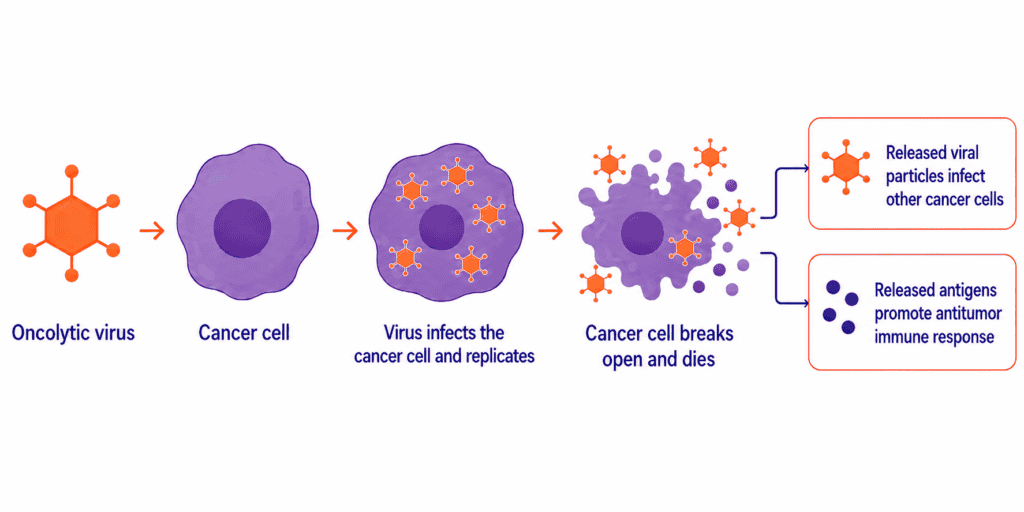
Oncolytic viruses can attack cancer in two related ways.
First, they attack cancer cells directly. The virus enters and infects a cancer cell, then makes copies of itself until the cell breaks apart and dies. This releases new viral particles that can go on to infect and kill nearby cancer cells.
But the effects don’t stop there. As cancer cells break apart, they release cancer-associated proteins and inflammatory signals that can attract immune cells and help the immune system recognize cancer cells as targets. Some oncolytic viruses are also engineered to produce molecules that further strengthen this immune response.
This immune activity is one reason researchers are combining oncolytic viruses with other immunotherapies. Checkpoint inhibitors such as nivolumab, for example, release molecular “brakes” that can limit T-cell activity, potentially enhancing the immune response initiated by an oncolytic virus.
How was oncolytic virus therapy discovered?
The idea of using viruses against cancer dates back more than a century. In 1904, physicians reported tumor regression in a patient during a viral infection. Researchers began deliberately testing naturally occurring viruses in people with cancer in the 1950s and 1960s. But these early approaches were difficult to control and raised safety concerns, including how to make sure the viruses attacked cancer cells without harming healthy tissue.
A major turning point came in the 1990s, when advances in genetic engineering allowed scientists to modify viruses to better target tumor cells and address some of these safety concerns.
In 2015, T-VEC (talimogene laherparepvec, Imlygic®) became the first FDA-approved oncolytic virus therapy in the U.S. It was approved for certain patients with melanoma.
The approval of Tudriqev more than a decade later adds another treatment to a still small category of approved cancer immunotherapies. Before Tudriqev, oncolytic viruses represented just one of 156 FDA cancer immunotherapy approvals tracked by the Cancer Research Institute (CRI).

What does the new melanoma approval mean?
Similar to T-VEC, Tudriqev is a genetically modified herpes simplex virus (HSV) that is injected directly into tumors. Its approval with nivolumab was based on the IGNYTE clinical trial in patients with advanced melanoma whose disease had progressed after treatment with a PD-1 checkpoint inhibitor.
The trial enrolled 140 patients. In the primary efficacy analysis, researchers assessed 91 patients who had at least one tumor that was not directly injected with Tudriqev. In this group, 24.2% had an objective response to treatment, meaning their tumors shrank by a predefined amount. Among those patients, the response lasted a median of 14.1 months.
What is an “accelerated approval”?
Tudriqev received accelerated approval, an FDA pathway that permits approval based on evidence reasonably likely to predict clinical benefit. As part of that approval, Replimune, the company that developed Tudriqev, must conduct additional research to confirm the clinical benefit of Tudriqev plus nivolumab. Continued approval may depend on those results.
What are the possible side effects?
As with most treatments, Tudriqev plus nivolumab can cause side effects. Common side effects in the trial included fatigue, fever, chills, nausea, injection-site reactions, and flu-like symptoms. Tudriqev also carries warnings about herpes infection and accidental exposure to the virus.
Talk with your health care team about the potential benefits and risks of treatment and what side effects to watch for.
Read CRI’s Patient’s Guide to Immunotherapy for Melanoma
What are researchers studying now?
For most cancers, oncolytic viruses remain experimental. Researchers are investigating how different tumors respond to these treatments and which combinations with other therapies may be most effective. CRI-network research includes:
- CRI Scientific Advisory Council Member Kai Wucherpfennig, MD, PhD, at Dana-Farber Cancer Institute, showed that patients with glioblastoma who received a single dose of an oncolytic virus had persistent activation of cancer-fighting T cells in their tumors. The findings show how oncolytic viruses can engage the immune system against brain tumors.
- CRI Clinical Accelerator Investigator Lawrence Fong, MD, at Fred Hutch Cancer Center, tested T-VEC with chemotherapy or endocrine therapy in patients with HR+/HER2-negative and triple-negative advanced breast cancer. The phase 1b trial found tumor responses and immune changes that support further investigation of this approach.
- CRI Chordoma Foundation CLIP Investigator Ke Pan, PhD, at The University of Texas MD Anderson Cancer Center, is examining engineered T cells with the oncolytic virus Delta-24-RGD for patients with chordoma. The study asks whether virus-driven tumor destruction and inflammation can help the engineered T cells attack cancer more effectively.
For patients in the U.S., approved oncolytic virus therapy is still limited to those with melanoma, but hundreds of other approaches are being tested for dozens of cancers in clinical trials. Researchers are continuing to determine where these therapies may be most useful and which patients are most likely to benefit.
Learn More
For a deeper introduction to oncolytic virus therapy, watch CRI’s “Infecting Cancer: How Viruses Are Turning the Tide Against Tumors” webinar below, featuring oncolytic virus researcher John Bell, PhD, at the Ottawa Hospital Research Institute. It is also available on YouTube.
Sources
FDA Grants Accelerated Approval to Vusolimogene Oderparepvec-Wtpg in Combination with Nivolumab for Melanoma
U.S. Food and Drug Administration (FDA), 2026
From Theory to Therapy: The History of Cancer Immunotherapy
Cancer Research Institute, 2025
FDA Approves Talimogene Laherparepvec to Treat Metastatic Melanoma
National Cancer Institute, 2025