
Immunotherapy for Breast Cancer
Explore immunotherapy for certain breast cancers and how biomarkers guide treatment
What Is Breast Cancer?
Breast cancer is the most commonly diagnosed cancer among women worldwide and a leading cause of cancer death. In 2024, approximately 2.4 million women were diagnosed with breast cancer globally, and about 694,000 died from the disease. In the U.S., an estimated 321,910 new cases of invasive breast cancer and 42,140 deaths are expected among women in 2026.
Breast Cancer Statistics
Worldwide
2nd
Most common cancer worldwide in 2024
2.4M
Women diagnosed worldwide in 2024
U.S.-Specific Statistics
321,910
New invasive cases expected among women in 2026
42,140
Deaths expected among women in 2026
92%
Five-year relative survival among women
Breasts are made up of fatty and connective tissues, glands called lobules (which can produce milk) and small tubes called ducts, which carry milk toward the nipple. Most breast cancers begin in the ducts or lobules, when cells in these tissues grow out of control. Breast cancer is much more common in women, but anyone with breast tissue can develop it. About 0.5% to 1% of breast cancers worldwide occur in men.
Breast cancers are broadly categorized as noninvasive or invasive. In noninvasive (stage 0) breast cancer, abnormal cells are contained and haven’t grown into the surrounding breast tissue. The most common form of noninvasive breast cancer is ductal carcinoma in situ (DCIS). About 20% to 25% of all newly diagnosed breast cancer cases in the U.S. are DCIS.
Invasive breast cancer has grown into surrounding tissue and potentially spread elsewhere in the body. The most common type is invasive ductal carcinoma, which accounts for about 70% to 80% of all breast cancers.
Breast cancers are also commonly grouped according to proteins found on or inside cancer cells:
- Hormone receptor-positive breast cancer has proteins called hormone receptors that respond to estrogen (ER), progesterone (PR), or both. These hormones can help cancer grow. Hormone receptor-positive breast cancer is the most common type of breast cancer, and hormone therapy is an important part of treatment.
- HER2-positive breast cancer has high levels of human epidermal growth factor receptor 2 (HER2), a protein involved in cell growth. Treatments that target HER2 can be very effective. Some HER2-positive cancers are also hormone receptor-positive.
- Triple-negative breast cancer (TNBC) does not have estrogen or progesterone receptors and does not have high levels of HER2. It often grows and spreads more quickly than many other types of breast cancers. Immunotherapy is an option for some people with TNBC.
There is no single cause of breast cancer. Factors that can increase risk include older age, a personal or family history of breast cancer, certain hereditary genetic mutations such as BRCA1 and BRCA2, dense breast tissue, previous radiation treatment to the chest, alcohol use, excess body weight after menopause, and certain forms of menopausal hormone therapy.
Some factors may help lower risk, including regular physical activity, maintaining a healthy weight, and limiting or avoiding alcohol. Breastfeeding is also associated with a lower risk of breast cancer.
When breast cancer is found early, before it spreads beyond the breast, the five-year relative survival rate among women is about 100%. Once the cancer has spread to nearby tissues or lymph nodes, the five-year relative survival is about 88%, and about 34% when it reaches distant parts of the body (metastatic disease).
However, outcomes are improving: breast cancer death rates among women in the U.S. have fallen by about 44% since 1989, largely because of earlier detection and better treatments. New targeted treatments and immunotherapy combinations continue to expand the options available to patients.
Is There Screening for Breast Cancer, and How Is It Diagnosed?
Yes. The routine screening test for breast cancer is a mammogram, a low-dose X-ray of the breast that can find some breast cancers before symptoms develop.
The U.S. Preventive Services Task Force (USPSTF) recommends that women at average risk have a mammogram every two years from ages 40 to 74. Other medical organizations recommend somewhat different screening schedules. Your health care team can help you decide when to begin screening and how often to have a mammogram based on your age, health, preferences, and individual risk.
People at higher risk may need a different screening plan. This can include earlier or more frequent mammograms and, for some people, breast magnetic resonance imaging (MRI).

What about ultrasound, MRI, or breast self-exams?
Ultrasound and MRI can be useful in certain situations, but they do not replace routine mammography for most people. Being familiar with how your breasts normally look and feel can also help you notice changes, but checking your breasts is not a substitute for recommended screening.
Dense breast tissue can make cancer harder to see on a mammogram and is itself associated with increased breast cancer risk. About 40-50% of women have dense breast tissue. Additional imaging may be appropriate for some people with dense breasts or other risk factors, but it can also identify abnormalities that turn out not to be cancer. Talk with your health care team about your individual risk and whether additional screening may be useful.
When breast cancer is suspected, your health care team may use a physical exam, diagnostic mammogram, ultrasound, or MRI to learn more. A diagnosis is usually confirmed with a biopsy, in which a sample of tissue is removed and examined under a microscope.
New breast changes should be checked even if your recent screening mammogram was normal.
After breast cancer is diagnosed, your health care team will test the tumor for hormone receptors and HER2 because these results help determine treatment. Depending on the type and stage of cancer, additional testing may include:
| Test / biomarker | Why it may matter |
|---|---|
| PD-L1 | Can help determine whether some patients with unresectable locally advanced or metastatic TNBC may benefit from immunotherapy. |
| BRCA1 and BRCA2 and other hereditary cancer-risk genes | Can identify a hereditary cancer risk and may affect treatment, screening, and prevention recommendations for you and your family. Some BRCA1 or BRCA2 gene mutations can also make certain breast cancers eligible for PARP inhibitors. |
| PIK3CA, AKT1, or PTEN tumor gene mutations | Can help identify patients with certain hormone receptor-positive, HER2-negative advanced breast cancers who may benefit from targeted treatment. |
| ESR1 tumor gene mutations | Can help guide hormone therapy for some patients with ER-positive, HER2-negative advanced breast cancer, particularly when the cancer has developed resistance to previous hormone therapy. |
| Microsatellite instability high (MSI-H) / Deficient DNA mismatch repair (dMMR) / Tumor mutational burden high (TMB-H) | Can sometimes make someone eligible for immunotherapy based on the tumor’s molecular features rather than where the cancer started. |
Genetic testing is now recommended for many people diagnosed with breast cancer, not only those with a strong family history. Age at diagnosis, cancer subtype, personal and family history, genetic ancestry, and potential treatment options can all affect whether testing is recommended. A genetic counselor or another clinician trained in cancer genetics can help explain what testing may be appropriate and what the results could mean for you and your family.
What Are the Symptoms of Breast Cancer?
Breast cancer can be difficult to detect early because it may not cause symptoms, which is one reason screening is important.
Possible symptoms include:
- A new lump or thickening in the breast or underarm
- A change in the size or shape of the breast
- Dimpling, puckering, or other changes in the breast skin
- A nipple that turns inward or changes position
- Nipple discharge other than breast milk, especially bloody discharge
- Redness, swelling, scaling, or thickening of the breast or nipple skin
- Pain in the breast or nipple that does not go away
Inflammatory breast cancer, a less common form of breast cancer, can cause distinct side effects, including rapid swelling, redness, warmth, or thickening of the breast skin, sometimes without a distinct lump.
When breast cancer has spread to other parts of the body, symptoms will depend on where it has spread and may include bone pain, shortness of breath, persistent headaches, or unexplained weight loss.
Having one of these symptoms does not necessarily mean you have breast cancer. Many breast changes have noncancerous causes. But if you notice a new lump, persistent pain, or an unusual change in your breast or nipple, talk to your health care team. Do not wait for your next screening mammogram.
Can Breast Cancer Be Prevented?
Not all breast cancers can be prevented, and many people who develop breast cancer do not have a clear preventable risk factor. However, understanding your personal and family history can help you identify whether you may be at higher risk and whether additional screening or risk-reducing options should be considered.
Some hereditary genetic mutations can substantially increase breast cancer risk. The best known involve BRCA1 and BRCA2, but other genes, including PALB2, TP53, PTEN, CDH1, and STK11, can also be associated with a higher risk. Having a hereditary genetic mutation does not mean that someone will definitely develop breast cancer, but it can affect screening and prevention recommendations and may also be important for family members.
Ways to help manage breast cancer risk include:
- Know your family history. Breast, ovarian, pancreatic, prostate, and other cancers can sometimes occur together as part of a hereditary cancer syndrome.
- Ask whether genetic counseling or testing is appropriate. Genetic testing can identify DNA mutations that affect breast cancer risk and may help guide screening and prevention decisions for you and your family.
- Discuss additional screening if you are at higher risk. Some people benefit from earlier or more frequent mammograms or a breast MRI.
- Consider risk-reducing medicines if appropriate. Hormone therapies such as tamoxifen or raloxifene can lower breast cancer risk in some people at increased risk.
- Discuss risk-reducing surgery if you are at high risk. For some people with certain hereditary genetic mutations or a very high lifetime risk of breast cancer, surgery to remove breast tissue can substantially lower risk.
- Focus on factors you can change. Regular physical activity, maintaining a healthy weight, and limiting or avoiding alcohol are associated with lower breast cancer risk. Breastfeeding is also associated with lower risk.
Screening does not prevent breast cancer, but it can help find cancer earlier, when treatment is often more effective.
How is Breast Cancer Treated?
Treatment for breast cancer depends on the type and stage of the cancer, hormone receptor and HER2 status, other tumor biomarkers, previous treatments, and a patient’s overall health. For many people with early-stage disease, surgery is an important part of treatment, often followed by radiation. Some patients receive medicines before surgery to shrink the tumor.
For advanced or recurrent disease, systemic treatments that travel throughout the body play a central role. These may include hormone therapy, chemotherapy, targeted therapies, and immunotherapy.
After surgery, many patients receive additional treatment to lower the risk of cancer returning. This may include hormone therapy for hormone receptor-positive cancer, HER2-targeted treatment for HER2-positive cancer, or other medicines for patients at higher risk. Hormone therapy is often continued for several years.
Breast cancer treatment has become increasingly personalized with the development of targeted therapies, antibody-drug conjugates (ADCs), and immunotherapy. In 2026, the U.S. Food and Drug Administration (FDA) approved a new first-line immunotherapy combination for certain patients with TNBC.
Immunotherapies Used to Treat Breast Cancer
Immunotherapy is a type of cancer treatment that uses your immune system to recognize and attack cancer cells. It can help immune cells overcome cancer’s defenses so they can better identify and fight the disease.
Immunotherapy is not used for everyone with breast cancer. It is currently approved for certain patients with high-risk, early-stage TNBC, some patients with advanced TNBC whose tumors express PD-L1, and a small number of patients whose tumors have certain biomarkers that make them eligible for immunotherapy regardless of cancer type.
Immune Checkpoint Inhibitors:
Immune checkpoint inhibitors (ICIs) are a type of immunotherapy that block immune checkpoints, such as PD-1, PD-L1, or CTLA-4. Blocking these signals releases a natural “brake” on your immune system, allowing immune cells to respond more effectively to cancer.
- Pembrolizumab (Keytruda®): Approved with chemotherapy before surgery and then alone after surgery for certain patients with high-risk, early-stage TNBC. For adults with unresectable locally advanced or metastatic TNBC whose tumors express PD-L1, pembrolizumab may be given as part of first-line treatment with chemotherapy or with sacituzumab govitecan (Trodelvy®). It blocks the PD-1 immune checkpoint.
Pembrolizumab also has FDA approvals that apply across cancer types to certain unresectable or metastatic tumors, including some breast cancers, that are MSI-H, dMMR, or TMB-H. - Dostarlimab (Jemperli®): Approved for certain patients with recurrent or advanced dMMR tumors, including some breast cancers, that have progressed after prior treatment and have no satisfactory alternative options. It blocks the PD-1 immune checkpoint.
Targeted Therapies Used to Treat Breast Cancer
Targeted therapies act on specific proteins or pathways that help cancer cells grow and survive. Some also help the immune system recognize and destroy cancer cells. Targeted therapies are not all immunotherapies, but understanding them can help explain why tumor biomarker and genetic testing are an important part of breast cancer care.
PARP Inhibitors:
PARP inhibitors block a protein that cells use to repair damaged DNA. Some breast cancer cells, especially those with BRCA1 or BRCA2 gene mutations, already have difficulty repairing DNA. Blocking the PARP protein can make it even harder for these cancer cells to survive.
PARP inhibitors are used for certain HER2-negative breast cancers in people with hereditary BRCA1 or BRCA2 gene mutations.
- Olaparib (Lynparza®): Approved after surgery for patients with high-risk, HER2-negative early breast cancer and a hereditary BRCA1 or BRCA2 gene mutation who received chemotherapy before or after surgery. It is also approved for certain patients with a hereditary BRCA1 or BRCA2 gene mutation who have HER2-negative metastatic breast cancer after chemotherapy.
- Talazoparib (Talzenna®): Approved for patients with a hereditary BRCA1 or BRCA2 gene mutation who have HER2-negative locally advanced or metastatic breast cancer.
Antibody and Antibody-Drug Conjugate (ADC) Therapies:
Antibody-based therapies use antibodies designed to recognize specific proteins on cancer cells. Some block signals that help cancer grow and help the immune system attack the cancer, while ADCs use the antibody to deliver cancer-killing medicine directly to tumor cells. These treatments are used for several breast cancer subtypes, depending on proteins such as HER2 or TROP-2. Examples include:
- Trastuzumab (Herceptin®) and pertuzumab (Perjeta®): Approved for patients with early-stage and metastatic HER2-positive breast cancer, usually with chemotherapy or other HER2-targeted medicines. Trastuzumab and pertuzumab are monoclonal antibodies that target HER2.
- Trastuzumab deruxtecan (Enhertu®): Used in several settings for HER2-positive breast cancer, including certain patients with early-stage cancers before or after surgery and as first-line treatment with pertuzumab for patients with unresectable or metastatic disease. It is also approved for certain previously treated HER2-low and HER2-ultralow breast cancers. Trastuzumab deruxtecan is an ADC that targets HER2.
- Sacituzumab govitecan (Trodelvy®): Approved as first-line treatment for patients with unresectable locally advanced or metastatic TNBC, with pembrolizumab for tumors with PD-L1, and alone when PD-1 or PD-L1 immunotherapy is not appropriate. It can also be used for certain previously treated TNBC and hormone receptor-positive, HER2-negative cancers. Sacituzumab govitecan is an ADC that targets TROP-2.
- Datopotamab deruxtecan (Datroway®): Approved for patients with unresectable or metastatic hormone receptor-positive, HER2-negative breast cancer after hormone therapy and chemotherapy for advanced disease. It may also be used in patients with unresectable or metastatic TNBC when PD-1 or PD-L1 inhibitor treatment is not appropriate. Datopotamab deruxtecan is an ADC that targets TROP-2.
Other Targeted Therapies:
Targeted therapies block specific proteins or signaling pathways that cancer cells use to grow, divide, or survive. Some are used based on the breast cancer subtype, while others require a particular biomarker or genetic mutation found through tumor testing. Many are given together with hormone therapy or other targeted treatments. Examples include:
- Tucatinib (Tukysa®) and neratinib (Nerlynx®): Approved for certain previously treated advanced HER2-positive breast cancers. Tucatinib is given with trastuzumab and capecitabine for advanced disease, while neratinib may be used after trastuzumab-based treatment for early-stage disease or with capecitabine for advanced disease. Both tucatinib and neratinib block HER2 signaling inside cancer cells.
- Abemaciclib (Verzenio®), ribociclib (Kisqali®), and palbociclib (Ibrance®): Approved with hormone therapy for certain patients with hormone receptor-positive breast cancer. All three can be used for advanced disease, while abemaciclib and ribociclib are also approved after surgery for higher-risk, early-stage cancers. These medicines block CDK4 and CDK6, proteins that help cells divide.
- Inavolisib (Itovebi®), capivasertib (Truqap®), and gedatolisib (Revtorpyk™): Used with hormone therapy for certain patients with advanced hormone receptor-positive, HER2-negative breast cancers. Which treatment may be appropriate depends in part on tumor biomarkers: inavolisib is used for PIK3CA gene mutations, capivasertib for certain PIK3CA, AKT1, or PTEN gene mutations, and gedatolisib when no PIK3CA gene mutation is detected. These medicines target the PI3K, AKT, and mTOR pathways that help cancer cells grow and survive.
- Elacestrant (Orserdu®), imlunestrant (Inluriyo™), vepdegestrant (Veppanu™), and camizestrant (Etcamah™): Approved for certain patients with estrogen receptor-positive, HER2-negative advanced or metastatic breast cancer with an ESR1 gene mutation. Elacestrant, imlunestrant, and vepdegestrant are used after progression on hormone therapy. Camizestrant is used with a CDK4/6 inhibitor when an ESR1 gene mutation appears during treatment and before scans show the cancer is growing. These medicines act on the estrogen receptor (ER).
Are There Immunotherapy Clinical Trials for Patients with Breast Cancer?
Yes. Immunotherapy is already part of standard treatment for some patients with breast cancer, and researchers are studying how to make immune-based treatments effective for more people.
Clinical trials may provide access to promising new approaches that are not yet widely available. They may be available at any stage of breast cancer treatment, not only after standard options have stopped working.
Researchers are studying several immunotherapy approaches, including:

Immune checkpoint inhibitors (ICIs) help release your immune system’s “brakes,” allowing it to better recognize and attack cancer. Researchers are testing new biomarkers and ways to extend their benefit to more breast cancer subtypes.

Therapeutic cancer vaccines train your immune system to recognize proteins or genetic changes found on cancer cells. Researchers are developing vaccines aimed at shared breast cancer targets, such as HER2, and personalized vaccines based on unique mutations in an individual patient’s tumor.

Cell and gene therapies use or engineer immune cells so they can better find and attack cancer. Researchers are evaluating tumor-infiltrating lymphocyte (TIL) therapy, chimeric antigen receptor (CAR) T-cell therapy, and engineered T-cell (TCR) therapy aimed at breast cancer targets such as HER2, mesothelin, and MUC1.

Immune cell engagers bring immune cells into direct contact with tumors. Researchers are developing antibodies that attach to both a cancer cell and an immune cell to help trigger an attack against breast cancer.

Combination approaches pair immunotherapy with other treatments to improve responses. Researchers are combining immunotherapy with chemotherapy, ADCs, targeted therapies, radiation, and cancer vaccines to learn whether different treatments can work together and which patients are most likely to benefit.
How Is CRI Advancing Breast Cancer Research?
Since the early 1980s, the Cancer Research Institute (CRI) has supported research aimed at understanding the immune response to breast cancer and developing better treatments. CRI has invested more than $12 million in breast cancer research grants and awards.
CRI-funded research has helped lay the groundwork for important advances in breast cancer biology. During his CRI postdoctoral fellowship at the Whitehead Institute for Biomedical Research, Mien-Chie Hung, PhD, helped clone the neu cancer gene, contributing to the scientific foundation that ultimately led to HER2-targeted treatments such as trastuzumab.
Today, CRI-funded scientists are exploring how to overcome resistance, strengthen anti-tumor immune responses, and identify which patients are most likely to benefit from immunotherapy, including:
- CRI Lloyd J. Old STAR Jennifer Guerriero, PhD, at Brigham and Women’s Hospital, is engineering immune cells called monocytes to target tumor-supporting macrophages, another type of immune cell that can protect cancer from attack. Her research aims to develop a new type of immunotherapy that removes these defenses, allowing cancer-fighting T cells to work more effectively.
- CRI CLIP Investigator Laura Mackay, PhD, at the University of Melbourne, is studying tissue-resident memory T cells, which are immune cells that remain in tissues and can help protect against breast cancer. Her research explores how these cells develop and become active, with the goal of finding treatments that increase their numbers or strengthen these cells inside tumors.
- CRI Immuno-Informatics Postdoctoral Fellow Maxime Meylan, PhD, at Dana-Farber Cancer Institute, is studying how the location and organization of cancer and immune cells affect treatment response in TNBC. His research may help explain why immune cells enter some tumors but are excluded from others.
- CRI Irvington Postdoctoral Fellow Michael Papanicolaou, PhD, at Stanford University, is studying whether age-related genetic changes in blood cells influence breast cancer recurrence and spread. His research explores whether these changes weaken immune defenses in other organs, potentially revealing new biomarkers and treatment strategies.

“We’re excited about using your own monocytes to overcome cancer therapy resistance and enhance immune responses.”
Jennifer Guerriero, PhD
CRI Lloyd J. Old STAR, Brigham and Women’s Hospital
Breast Cancer Statistics
Worldwide
2nd
Most common cancer worldwide in 2024
2.4M
Women diagnosed worldwide in 2024
U.S.-Specific Statistics
321,910
New invasive cases expected among women in 2026
42,140
Deaths expected among women in 2026
92%
Five-year relative survival among women
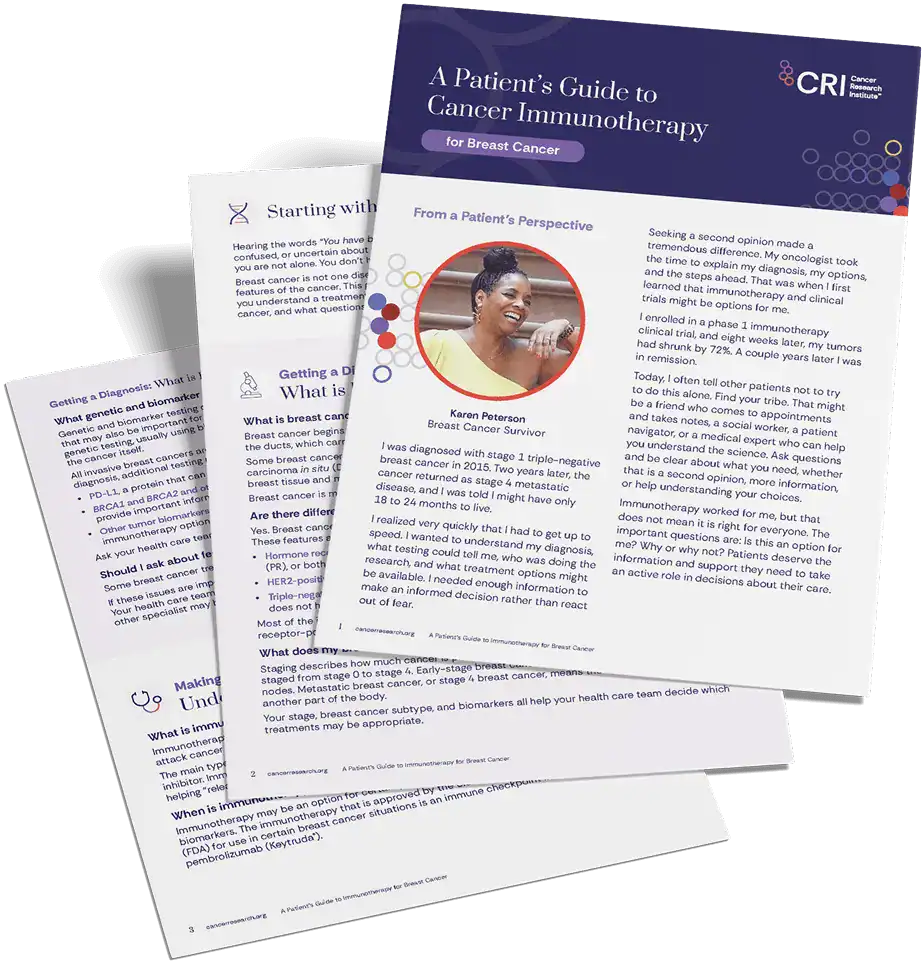
A Patient’s Guide to Immunotherapy for Breast Cancer
Your path to understanding breast cancer immunotherapy — guided by survivors, experts, and hope.
Find a Clinical Trial Near You

Sources
Breast Cancer
(2026) American Cancer Society (ACS)
Key Statistics for Breast Cancer
(2026) ACS
Cancer Stat Facts: Female Breast Cancer
(2026) National Cancer Institute (SEER)
Cancer Facts & Figures 2026
(2026) ACS
Cancer Statistics, 2026
(2026) CA: A Cancer Journal for Clinicians
Breast Fact Sheet
(2024) GLOBOCAN, International Agency for Research on Cancer
Global Cancer Statistics 2024
(2026) CA: A Cancer Journal for Clinicians
Breast Cancer: Screening
(2024) U.S. Preventive Services Task Force
FDA Approves Sacituzumab Govitecan-hziy as Monotherapy and in Combination With Pembrolizumab for First-Line Triple-Negative Breast Cancer
(2026) U.S. Food and Drug Administration (FDA)
Oncology (Cancer)/Hematologic Malignancies Approval Notifications
(2014–2026) U.S. FDA
Join CRI in Shaping the Future of Immunotherapy
Support the pioneering work of CRI in advancing cancer research.