

Due to her Lynch syndrome, Adrienne Skinner was vigilant about routine cancer screenings. Lynch syndrome significantly increases the risk of developing certain cancers, often at a younger age than expected. Still, nothing could prepare her for the diagnosis she received: a rare, stage 4 ampullary cancer with a grim prognosis.
After multiple chemotherapy regimens failed, Adrienne was offered a final option — a clinical trial testing an immunotherapy. That treatment ultimately saved her life.
Today, Adrienne takes advantage of the time she was given to play tennis, practice yoga, spend time with her four daughters and grandsons, and enjoy a vibrant life. She gives back, shares her story, and offers hope to others facing rare cancers.
What is Lynch Syndrome?
Lynch syndrome is a hereditary genetic condition caused by mutations in DNA mismatch repair genes. These mutations prevent the body from effectively repairing DNA damage, increasing the risk of uncontrolled cell growth and cancer. People with Lynch syndrome are at significantly higher risk of developing several cancers, often earlier in life.
If a parent carries a Lynch syndrome gene mutation, each biological child has a 50% chance of inheriting the condition.
Because Lynch syndrome can go undetected until cancer develops, understanding your genetic risk is critical. Genetic testing and regular cancer screenings are essential for early detection and successful treatment.
Cancers commonly associated with Lynch syndrome include colorectal, endometrial, ovarian, stomach, liver, gallbladder, and bile duct cancers. The ampullary cancer Adrienne developed falls within the category of bile duct cancers.
What are Gallbladder and Bile Duct Cancers?
February is Gallbladder and Bile Duct Cancer Awareness Month, a time dedicated to increasing understanding of these rare and often overlooked cancers. Awareness efforts focus on improving early detection, advancing research efforts, and sharing patient journeys — like Adrienne’s — that highlight the urgent need for better treatment options, forward momentum, and continued progress.
Gallbladder and bile duct cancers occur when abnormal cells grow uncontrollably in the bile ducts or gallbladder. Bile ducts are a network of thin tubes that transport bile from the liver and gallbladder to the small intestine. Bile is a thick fluid that plays a crucial role in digestion and helps the body eliminate waste products filtered from the bloodstream.
Because these organs are located deep within the body and there is currently a lack of effective screening tools, gallbladder and bile duct cancers are often diagnosed at advanced stages, after symptoms appear. Only about one in five cases is detected early.
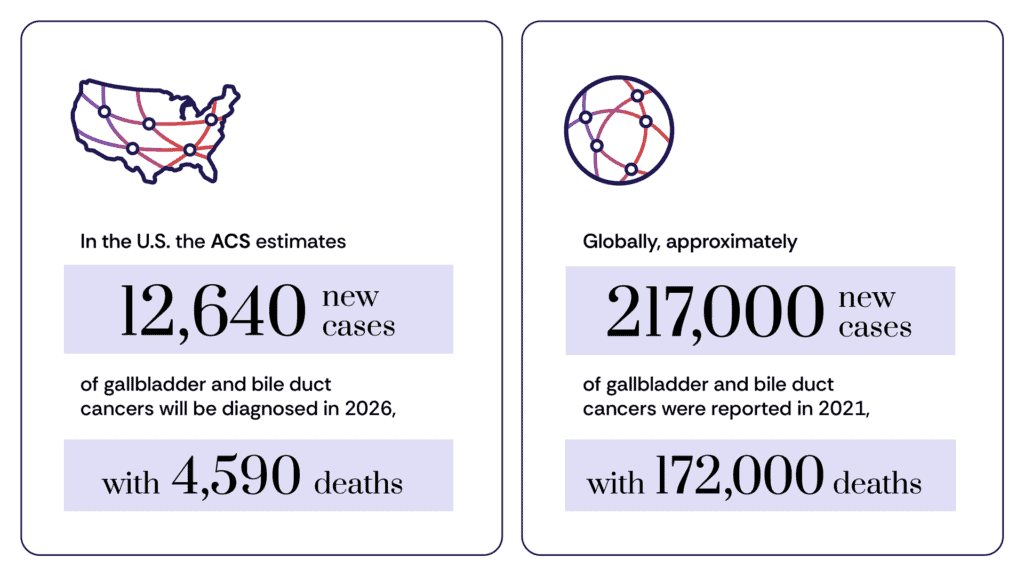
Adrienne’s Diagnosis and a Turning Point
Adrienne’s cancer originated in the ampulla of Vater, a small opening that connects the pancreatic and bile ducts to the small intestine. Ampullary cancer is extremely rare, accounting for about 7% of periampullary cancers and less than 1% of all gastrointestinal cancers.
By the time her cancer was discovered, doctors estimated it had been developing for nearly two years and had spread to her liver. Treatment options were limited, and chemotherapy was not effective. Adrienne became increasingly ill and exhausted.
Then, she was offered a chance to join a clinical trial testing an immunotherapy for cancers with a specific genetic marker — one present in her tumor. Although she was not initially considered an ideal candidate, Adrienne advocated for herself and ultimately enrolled in the trial. She was treated with the immunotherapy Keytruda® (pembrolizumab).
What is Immunotherapy?
Immunotherapy is a type of cancer treatment that helps your immune system recognize and destroy cancer cells. While your immune system is designed to protect the body from threats, some cancers can evade detection or suppress immune responses.
Immunotherapy works by “unmasking” cancer cells and removing barriers that prevent the immune system from attacking them. In some cases, immunotherapy can eliminate cancer and reduce the risk of recurrence.
Within months of starting Keytruda, Adrienne’s cancer disappeared. One surgeon told her, “If someone hadn’t told me you had ampullary cancer, I wouldn’t have believed it. There’s just nothing there.”
That was in 2014, and Adrienne has remained without evidence of disease ever since.
Immunotherapy in Gallbladder and Bile Duct Cancer
Immunotherapy has begun to transform the treatment landscape for advanced gallbladder and bile duct cancers, primarily through immune checkpoint inhibitors (ICIs). These treatments help the immune system recognize and attack cancer cells by blocking inhibitory signals like PD-L1 and CTLA4 — essentially releasing the “brakes” on immune responses.
ICIs used in gallbladder and bile duct cancers include:
- PD-1/PD-L1 inhibitors: ImfinziⓇ (durvalumab), Keytruda (pembrolizumab), OpdivoⓇ (nivolumab)
- CLTA-4 inhibitors: YervoyⓇ (ipilimumab)
Treatment decisions depend on the specific cancer type and genetic features of the tumor. Patients should speak with their health care team to determine whether immunotherapy may be an appropriate option.
Ongoing Research is Providing Hope
Not all gallbladder and bile duct cancers respond to current immunotherapies. Researchers continue to explore new therapies, including combination therapies and emerging approaches such as CAR T-cell therapy and cancer vaccines.
Facing a Cancer Diagnosis
Whether you or a loved one has been diagnosed with cancer, the experience can feel overwhelming. Being your own best advocate matters. Learn about your cancer type, ask questions, explore treatment options and clinical trials, and don’t hesitate to seek second opinions.
Most importantly, lean on your support system. No one should face cancer alone. See our Patient’s Guide to Cancer Immunotherapy for additional resources.
To learn more about clinical trials and find one that may be suitable for you or your loved one, visit our Clinical Trials page, or call 855-216-0127 to speak with a Clinical Trial Navigator.
Frequently Asked Questions
How does immunotherapy differ from chemotherapy?
Unlike chemotherapy, which introduces drugs to attack cancer cells, immunotherapy is designed to work with the body to activate the immune system against cancer. Activating the immune system can help eliminate tumors and also ensure that they do not return.
Side effects from immunotherapy differ from those of chemotherapy and can vary from person to person. It is again important to speak with your health care team to understand the benefits and risks of any treatment route.
Learn more about the differences between immunotherapy and chemotherapy.
Is immunotherapy right for everyone with gallbladder and bile duct cancers?
Immunotherapy is the right option for some patients. It’s important to talk with your healthcare team to determine if it’s right for you or your loved ones. Ongoing research in immunotherapy aims to bring more options to more patients.
How do doctors decide when immunotherapy might be right?
Your health care team will consider your specific cancer type, stage, prior therapies, and overall health to determine if immunotherapy is right for you. Not every patient will benefit from immunotherapy for their cancer, so it’s important to discuss with your doctor what options are available to you.
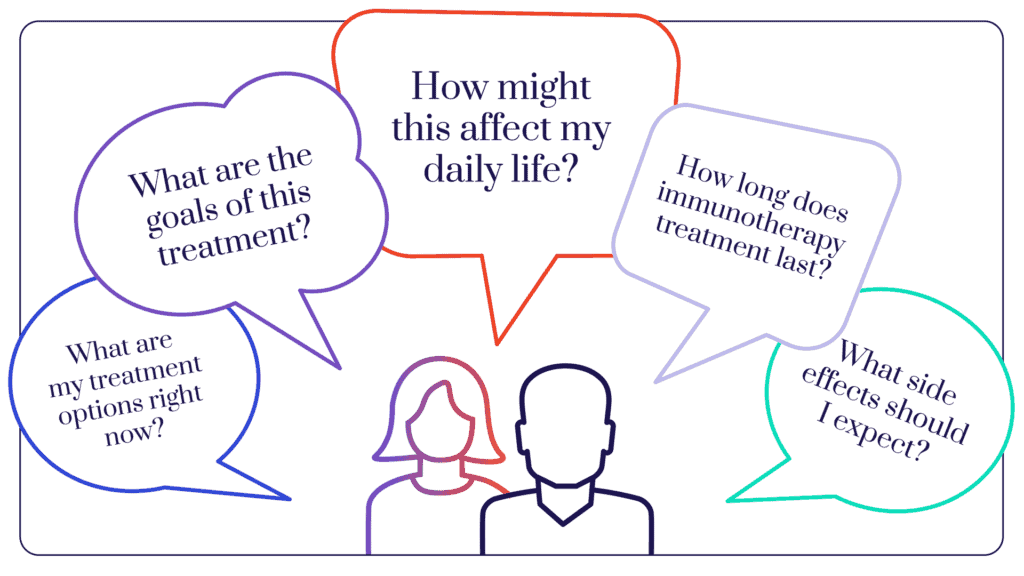
What other questions should I ask my health care team about immunotherapy?
There are several questions you may have for your health care team about your treatment that can help you feel empowered and informed to make the right decisions:
What gives doctors and researchers hope about the future of gallbladder and bile duct cancer treatment?
Ongoing research is focusing on even more effective immunotherapies for more patients with different cancer characteristics.
The ongoing work is not only growing the list of treatment options for patients, but is grounded in patient voices that are shaping research. The future of gallbladder and bile duct cancer treatment aims to give every patient more hope and more time.
- https://www.cancer.org/cancer/types/gallbladder-cancer/about/key-statistics.html
- https://pubmed.ncbi.nlm.nih.gov/24857067/
- https://www.frontiersin.org/journals/immunology/articles/10.3389/fimmu.2025.1559465/full
- https://www.cancer.org/cancer/types/bile-duct-cancer/treating/immunotherapy.html#:~:text=These%20drugs%20are%20given%20as,side%20effects%20occur%20less%20often
- https://www.mayoclinic.org/diseases-conditions/lynch-syndrome/symptoms-causes/syc-20374714