
Immune Checkpoint Inhibitors
Learn how checkpoint inhibitors help your immune system fight cancer
Immune checkpoint inhibitors (ICIs) are a widely used type of immunotherapy that helps your immune system recognize and attack cancer. They work by blocking signals that can hold immune cells back, essentially releasing the immune system’s natural “brakes.”
The first checkpoint inhibitor was approved by the U.S. Food and Drug Administration (FDA) in 2011. Today, these treatments are used for many cancer types, sometimes alone and sometimes in combination with chemotherapy, radiation, targeted therapy, or other immunotherapy. They can be used for advanced cancers as well as before or after surgery for some earlier-stage cancers.
Checkpoint inhibitors are a very effective treatment for many people, but they do not work for everyone. Whether they may help depends on the cancer type and stage, biomarkers, previous treatment, and the patient’s overall health.
| KEY FACTS ABOUT IMMUNE CHECKPOINT INHIBITORS | |
|---|---|
| How they work | Immune checkpoints are signals that help keep T cells from becoming too active. Checkpoint inhibitors block those signals, helping T cells stay active and attack cancer. |
| How they are given | Most checkpoint inhibitors are given through an IV (intravenous) at a cancer center or infusion clinic. Some may also be injected under the skin (subcutaneous). |
| When they are used | Checkpoint inhibitors are approved to treat more than 20 types of cancer, including lung cancer, melanoma, kidney cancer, bladder cancer, head and neck cancer, and many others. |
| What the side effects are | The most common side effects are fatigue, rash or itchiness, and diarrhea. More serious side effects are less common but can affect organs such as the liver, kidneys, thyroid, or hormone-producing glands |
| What researchers are studying | Researchers are working to understand who benefits from checkpoint inhibitors, why treatment sometimes stops working, and how to make treatment safer and more effective. |
What Are Immune Checkpoint Inhibitors, and How Do They Work?
Your immune system has built-in safeguards that prevent immune cells from becoming too active and damaging healthy tissue. Some of these safeguards are proteins called immune checkpoints.
T cells, a type of immune cell, use these checkpoint signals to help determine when to slow down or stop an immune response. Cancer can take advantage of the same system. For example, some cancer cells have high levels of a protein called PD-L1. When PD-L1 interacts with a partner protein called PD-1 on a T cell, it can send a signal that reduces the T cell’s activity and helps prevent the T cell from attacking the cancer.
Checkpoint inhibitors are laboratory-made antibodies that block these signals. Some block checkpoint proteins on T cells, such as PD-1, CTLA-4, or LAG-3. Others bind PD-L1, which can be found on cancer cells and immune cells. By interrupting these signals, checkpoint inhibitors can help T cells stay active and attack cancer.
This is different from treatments such as chemotherapy, which acts directly on rapidly dividing cells. Checkpoint inhibitors change immune signaling so that your immune system can better respond to the cancer. In some patients, that immune response can be long-lasting, even after treatment has stopped.
Checkpoint inhibitors are one of six major types of cancer immunotherapy: immune checkpoint inhibitors, cell and gene therapies, cancer vaccines, immune cell engagers, oncolytic virus therapy, and cytokines and immune-stimulating agents. They may be used alone, together with another immunotherapy, or with treatments such as surgery, chemotherapy, radiation, or targeted therapy.

A Nobel Prize-Winning Breakthrough
The science behind checkpoint inhibition was recognized with the 2018 Nobel Prize in Physiology or Medicine, awarded to James P. Allison, PhD, a longtime CRI-funded scientist and Director of CRI’s Scientific Advisory Council, and Tasuku Honjo, MD, PhD.
What Types of Immune Checkpoint Inhibitors Are There?
Checkpoint inhibitors are generally grouped by the immune checkpoint protein they block. The FDA has approved 15 checkpoint inhibitors targeting four checkpoint pathways. PD-1 and PD-L1 inhibitors make up the largest group and are used across many different types of cancer.
| Type of checkpoint inhibitor | HOW THEY WORK | APPROVED TREATMENTS |
|---|---|---|
| PD-1 inhibitors | Block PD-1, a checkpoint protein on T cells | Pembrolizumab (Keytruda®), nivolumab (Opdivo®), cemiplimab (Libtayo®), dostarlimab (Jemperli®), retifanlimab (Zynyz®), toripalimab (Loqtorzi®), tislelizumab (Tevimbra®), and penpulimab |
| PD-L1 inhibitors | Block PD-L1, a partner of PD-1 that can be found on tumor cells and immune cells | Atezolizumab (Tecentriq®), durvalumab (Imfinzi®), avelumab (Bavencio®), and cosibelimab (Unloxcyt®) |
| CTLA-4 inhibitors | Block CTLA-4, a checkpoint protein on T cells | Ipilimumab (Yervoy®), tremelimumab (Imjudo®)* |
| LAG-3 inhibitors | Block LAG-3, a checkpoint protein on T cells | Relatlimab, which is only available in combination with nivolumab as Opdualag® |
*These CTLA-4 inhibitors may be used in combination with a PD-1 or PD-L1 inhibitor, depending on the type of cancer.
Most checkpoint inhibitors are given by IV infusion. The FDA has also approved three versions of checkpoint inhibitors that can be injected under the skin (subcutaneous): atezolizumab with hyaluronidase-tqjs (Tecentriq Hybreza®), nivolumab with hyaluronidase-nvhy (Opdivo Qvantig®), and pembrolizumab with berahyaluronidase alfa-pmph (Keytruda Qlex®).
Who Might Benefit From an Immune Checkpoint Inhibitor?
Checkpoint inhibitors are FDA-approved for certain patients with different cancers, including melanoma and other skin cancers, lung, kidney, bladder, head and neck, gastrointestinal, gynecologic, and breast cancers, as well as mesothelioma and certain lymphomas.
However, having one of these cancers does not necessarily mean a checkpoint inhibitor is an option. The right checkpoint inhibitor depends on more than the type of cancer. Some treatments are approved only for certain cancer subtypes, stages, age groups, or treatment histories. In some cases, eligibility is based on a tumor biomarker rather than where the cancer started.
Doctors consider several factors when deciding whether a checkpoint inhibitor may be appropriate:
- Type and stage of cancer and treatment goal: Checkpoint inhibitors are used for some advanced disease and in a growing number of earlier-stage settings. Depending on the cancer, treatment may be given before surgery, after surgery to lower the risk of recurrence, or to control cancer that cannot be surgically removed.
- Biomarkers: Some checkpoint inhibitors require testing for biomarkers such as PD-L1, microsatellite instability-high (MSI-H), mismatch repair deficiency (dMMR), or tumor mutational burden-high (TMB-H). The test and cutoff can differ by cancer and treatment.
- Other tumor features: Genetic mutations and other characteristics of the cancer may influence whether another treatment should be used instead of, before, or together with immunotherapy.
- Previous treatments: Some checkpoint inhibitors are approved as a first treatment, while others are used after chemotherapy or other therapies have stopped working. Prior immunotherapy treatment can also affect which options are available.
- Overall health and medical history: Autoimmune conditions, previous organ or stem-cell transplantation, medicines that suppress the immune system, certain organ problems, and pregnancy or plans for pregnancy may affect the risks and benefits of treatment.
Can Biomarkers Qualify Someone for Treatment Regardless of Cancer Type?
Sometimes. In 2017, pembrolizumab became the first cancer treatment approved by the FDA based on a tumor biomarker rather than the part of the body where the cancer started.
Today, some people with advanced solid tumors that are MSI-H, dMMR, or TMB-H may be eligible for a checkpoint inhibitor under these “tumor-agnostic” approvals. Eligibility still depends on the specific approval, including factors such as age, previous treatment, and available treatment alternatives.
What Can I Expect if I Receive a Checkpoint Inhibitor?
The details depend on the checkpoint inhibitor and whether it is being given alone or with other treatments.
Most checkpoint inhibitors are given by IV infusion at a cancer center or infusion clinic. Some can be given as an injection under the skin. Depending on the treatment, doses may be several weeks apart.
Before and during treatment, your health care team may use blood tests, imaging scans, physical exams, and other tests to monitor the cancer and look for side effects. Because checkpoint inhibitors work through the immune system, doctors may also monitor organs such as your liver, kidneys, thyroid, and other hormone-producing glands.
Length of treatment can vary. Some treatments are given for a set period of time or number of doses, while others may continue until the cancer progresses, side effects become unacceptable, or a planned course is completed.
10 Questions to Ask Your Doctor
Being diagnosed with cancer may feel overwhelming, and understanding your treatment options can make a big difference. Asking the right questions can help you take an active role in your care, make informed decisions, and feel more confident as you move forward.
Here are 10 key questions to use in your conversations with your doctor to talk about cancer and immune checkpoint inhibitors.
1
Is a checkpoint inhibitor approved or recommended for my cancer subtype and stage?
2
What is the goal of treatment: curing the cancer, lowering the risk that it returns, or controlling it?
3
Which biomarker and genetic tests do I need, and what do my results mean for eligibility and expected benefit?
4
What benefit has this treatment shown in people with cancer like mine?
5
Why are you recommending this checkpoint inhibitor alone or in combination with another treatment?
6
What additional benefits and side effects might come from combination treatment?
7
How often will I receive treatment, and how will we determine whether it is working?
8
Which side effects should I report right away?
9
How could my autoimmune condition, transplant history, other medicines, or pregnancy plans affect treatment?
10
Is there a clinical trial I should consider?
What Side Effects Can Immune Checkpoint Inhibitors Cause?
Because checkpoint inhibitors increase immune activity, the immune system can sometimes affect healthy organs and tissues along with the cancer. These are called immune-related adverse events, or immune-related side effects.
They can affect almost any part of your body. Examples include your skin (rash, itching), gut (diarrhea, colitis), hormone-producing glands such as your thyroid, pituitary, and adrenal glands, lungs, liver, kidneys, joints, heart, and nervous system.
Side effects vary widely from person to person and can develop during treatment or after treatment has ended.
Not every side effect is caused by the immune system. Fatigue and infusion- or injection-related reactions can also occur. If checkpoint therapy is combined with chemotherapy, targeted therapy, or another treatment, those treatments have their own possible side effects as well.
Many immune-related side effects are mild to moderate and can be managed, especially when recognized and treated early. Treatment may include temporarily stopping the checkpoint inhibitor and using medicines such as corticosteroids to reduce immune activity. Some hormone-related side effects can be permanent and may require long-term hormone replacement.

Contact your doctor right away about any new or worsening symptom, even if it seems minor or occurs after treatment has ended. Your health care team can tell you which symptoms require urgent or emergency care.
Symptoms that may need immediate attention include severe diarrhea, new or worsening shortness of breath, chest pain, a severe headache, vision changes, significant muscle weakness, confusion, or a rash that spreads or blisters.
Are There Clinical Trials, and What Are Researchers Studying?
Yes. Clinical trials are carefully monitored research studies that test new treatments or new ways of using existing treatments. They may be available at any stage of cancer treatment, not only after standard options have stopped working
Clinical trials are helping researchers answer some of the biggest remaining questions about who benefits, why treatment stops working, how early immunotherapy should be used, and how to make treatment safer.
Why do checkpoint inhibitors work for some people but not others?
Some cancers respond well to checkpoint inhibitors, while others do not. Researchers are studying better biomarkers and features of the tumor microenvironment to better predict who is most likely to benefit.
Why does treatment sometimes stop working?
Some cancers resist checkpoint inhibitors from the start, while others respond and later begin growing again. Researchers are studying new checkpoint targets, combination treatments, and bispecific or multi-specific antibodies to better understand and overcome this resistance.
Can checkpoint inhibitors help more people if they are given earlier?
Checkpoint inhibitors are increasingly being studied and used before surgery, after surgery, or across both periods. Researchers are testing whether earlier treatment can improve immune responses, lower the risk of recurrence, and help identify which patients need additional therapy.
Can serious immune-related side effects be predicted or prevented?
Researchers are investigating why checkpoint inhibitors cause immune-related side effects in some patients and whether certain people are at greater risk. The goal is to detect, prevent, and treat these effects earlier without weakening the anticancer immune response.
How Has CRI Helped Make Checkpoint Inhibitors Possible?
Checkpoint inhibitors are now a major part of cancer treatment. However, the idea that releasing the immune system’s brakes could treat cancer was once unproven, and CRI helped support the research that changed that.
In 1992, CRI began funding research in the laboratory of Dr. James P. Allison, then at University of California, Berkeley, before checkpoint blockade had been shown to work against cancer. In the years that followed, Dr. Allison helped establish CTLA-4 as a brake on T-cell activity and then demonstrated that blocking it could unleash an immune response capable of rejecting tumors.
In 2011, ipilimumab (Yervoy®), a treatment based on CTLA-4 blockade, became the first immune checkpoint inhibitor approved by the FDA. Dr. Allison and Tasuku Honjo, MD, PhD, later shared the 2018 Nobel Prize in Physiology or Medicine for discoveries that established cancer therapy by blocking negative immune regulation.
CRI-supported scientists also helped establish the scientific foundation for targeting another checkpoint that would become central to cancer treatment: PD-1. In 2006, then CRI postdoctoral fellows E. John Wherry, PhD, and David Masopust, PhD, working with Rafi Ahmed, PhD, Emory University, showed that blocking PD-1 could restore the activity of exhausted T cells. This study helped demonstrate that an immune response thought to be spent could be reinvigorated.
Those discoveries changed the central question in cancer immunology. Researchers no longer had to ask simply whether the immune system could be used to treat cancer. They could begin asking how to make that response work for more people, make it last longer, and make it safer.
How CRI is Advancing Checkpoint Inhibitor Research
Baolin Liu, PhD, at the Broad Institute of MIT and Harvard

The CRI Immuno-Informatics Postdoctoral Fellow is combining single-cell data from hundreds of melanoma tumors with CRISPR screening and machine learning to identify the genes that directly contribute to response or resistance to checkpoint immunotherapy. This work could identify new treatment targets for patients who do not respond to existing checkpoint inhibitors.
Ayano Kohlgruber, PhD, at Boston Children’s Hospital

The CRI Technology Impact Award Investigator is studying why checkpoint inhibitors cause inflammatory arthritis in some patients. By identifying which healthy tissues are mistakenly targeted by activated T cells, her research could lead to better ways to predict, diagnose, and manage immune-related side effects.
Peiwen Chen, PhD, at Cleveland Clinic

The CRI CLIP Investigator is investigating how immune-suppressing myeloid cells contribute to resistance to PD-1 therapy in glioblastoma. His team is targeting a pathway that helps these cells accumulate and survive around tumors, with the goal of making resistant brain cancers more responsive to checkpoint inhibition.
Thomas Urban Marron, MD, PhD, at the Icahn School of Medicine at Mount Sinai

The CRI Clinical Innovator is leading an early-phase clinical trial testing whether blocking IL-4 can improve the effectiveness of PD-1 inhibition in non-small cell lung cancer. The study is evaluating the combination’s safety and biological effects in patients with resectable disease whose cancer has not responded as expected to standard PD-1 or PD-L1 therapy.
Last updated
Checkpoint Inhibitors Statistics
15
Approved by the FDA
20+
Cancers treated
7K+
Ongoing clinical trials
67
Approvals in the last five years
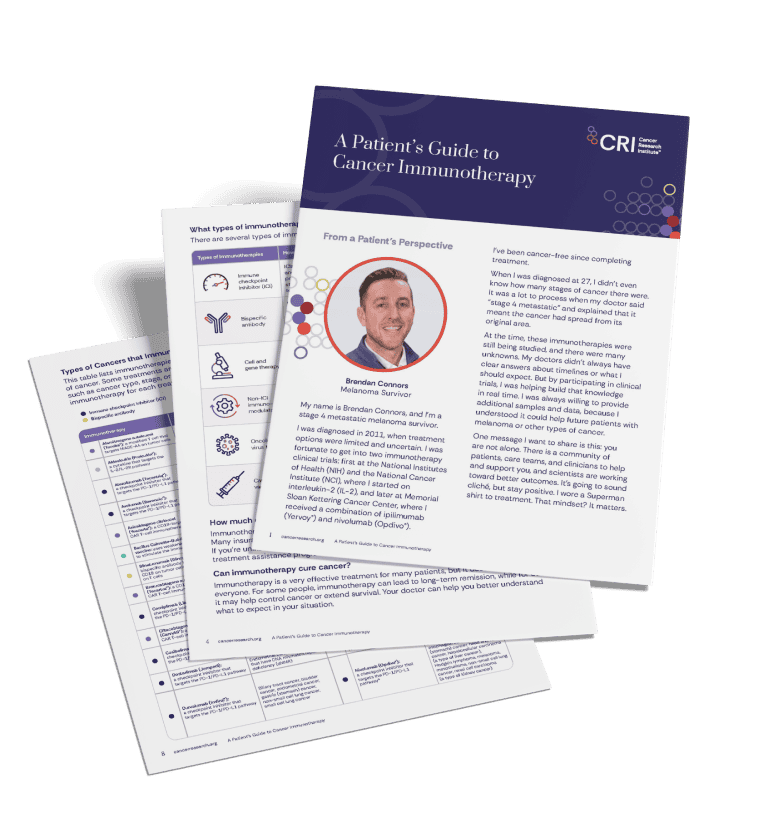
A Patient’s
Guide to Cancer Immunotherapy
Your path to understanding immunotherapy— guided by survivors, experts, and hope.
Find a Clinical Trial Near You

Sources
Drugs@FDA: FDA-Approved Drugs
U.S. Food and Drug Administration (FDA)
Oncology (Cancer)/Hematologic Malignancies Approval Notifications
U.S. FDA
Management of Immune-Related Adverse Events in Patients Treated With Immune Checkpoint Inhibitor Therapy
(2021) Journal of Clinical Oncology
Immune Checkpoint Inhibitors
National Cancer Institute
How Many People in the US Are Eligible for and Respond to Checkpoint Inhibitors
(2025) International Journal of Cancer
The Nobel Prize in Physiology or Medicine 2018
(2018) The Nobel Prize
Next-Generation Immune Checkpoints and Tumor Microenvironment Modulation in Cancer Immunotherapy
(2026) Journal of Immunology Research
The Landscape of Bispecific Antibodies in Solid Tumor Oncology
(2025) Cancer Medicine
Circulating Tumor DNA Clearance as a Predictive Biomarker of Pathologic Complete Response in Patients With Solid Tumors Treated With Neoadjuvant Immune Checkpoint Inhibitors
(2025) Annals of Oncology
Join CRI in Shaping the Future of Immunotherapy
Support the pioneering work of CRI in advancing immunotherapy.