
Immunotherapy for Lung Cancer
Learn how immunotherapy helps treat lung cancer
What Is Lung Cancer?
Lung cancer is the most commonly diagnosed cancer and the leading cause of cancer death worldwide. In 2022, approximately 2.6 million people were diagnosed with lung cancer, and more than 1.8 million died from the disease. In the U.S., an estimated 229,410 new cases and 124,990 deaths are expected in 2026.
Lung Cancer Statistics
Worldwide
#1
Most commonly diagnosed cancer and leading cause of cancer death
2.6M
New cases each year
1.9M
Deaths each year
10-20%
Of people diagnosed have never smoked
U.S.-Specific Statistics
229,410
New cases expected in 2026
124,990
Deaths expected in 2026
32%
Overall five-year survival rate for non-small cell lung cancer (NSCLC)
9%
Overall five-year survival rate for small cell lung cancer (SCLC)
Lung cancer begins when cells in your lungs or airways grow out of control. It is generally divided into two main types:
- Non-small cell lung cancer (NSCLC), which makes up about 80–85% of cases. Its main subtypes are adenocarcinoma, which often forms in the outer parts of the lung; squamous cell carcinoma, which arises in the airways; and large cell carcinoma, which often occurs in the lung’s outer edges.
- Small cell lung cancer (SCLC), which makes up about 10-15% of cases. It usually grows and spreads more quickly than NSCLC and is almost always associated with smoking tobacco.
Smoking is the leading cause of lung cancer, but anyone can develop the disease. Other risk factors include secondhand smoke, radon gas, asbestos and other workplace carcinogens, air pollution, a family history of lung cancer, and previous radiation therapy to the chest. About 10–20% of lung cancers occur in people who have never smoked.
The genetic changes that contribute to lung cancer can differ between people who have and have not smoked. Lung cancers in people who have never smoked are more likely to have tumors with certain genetic mutations, such as changes in the EGFR, ALK, ROS1, RET, or HER2 genes, that may be treated with targeted therapy.
Lung cancer often causes no symptoms in its early stages, so many cases are found only after the cancer has grown beyond its original location, when it may be harder to treat. When NSCLC is found early, before it has spread, the five-year relative survival rate is about 67%. Once it has spread to distant parts of the body, the rate is about 12%. Patient outcomes have continually improved over the last 10 years as more people receive screening and as immunotherapies and targeted treatments have become available.
What Is Lung Cancer Screening, and How Is Lung Cancer Detected?
Lung cancer screening can find the disease before symptoms appear, when it may be easier to treat. The American Cancer Society recommends yearly screening with a low-dose computed tomography, also called low-dose CT or LDCT scan, for adults who:
- Are 50- to 80-years-old
- Have at least a 20 pack-year smoking history
Current screening recommendations do not include everyone who can develop lung cancer, including people who have never smoked and some former smokers. Researchers are studying whether additional risk factors or more personalized approaches could help identify others who may benefit from screening. If you do not meet the current criteria, talk with your health care team about your individual risk.
When lung cancer is suspected because of a screening or symptoms, imaging tests such as CT or PET scans may be used to examine your lungs. A biopsy is usually needed to confirm the diagnosis and identify the type of lung cancer.
For many people with NSCLC, the tumor should also be tested for biomarkers that can help guide treatment. These may include a PD-L1 test and genetic mutations in EGFR, ALK, ROS1, BRAF, KRAS, MET, RET, NTRK, HER2, or other genes.
What Are the Symptoms of Lung Cancer?
Lung cancer may not cause symptoms in its early stages, but possible symptoms include:
- A cough that does not go away or gets worse
- Chest pain
- Shortness of breath or wheezing
- Hoarseness
- Coughing up blood
- Frequent lung infections, such as bronchitis or pneumonia
- Unexplained weight loss
- Fatigue
If lung cancer has spread beyond the lungs, it may cause other symptoms, such as bone pain, headaches, or dizziness.
These symptoms are more often caused by other health conditions and do not always mean that you have cancer. Talk with your health care team about symptoms that are new, unusual, or do not go away, even if you do not meet the criteria for lung cancer screening.
Can Lung Cancer Be Prevented?
Not all lung cancers can be prevented, but several steps can help lower your risk. The single most effective step is avoiding tobacco.
- Don’t smoke, or quit if you do. Quitting at any age reduces lung cancer risk, and the benefits increase over time.
- Avoid secondhand smoke. Make your home and car smoke-free, and avoid indoor spaces where smoking is allowed when possible.
- Test your home for radon. Radon is a naturally occurring radioactive gas and the second leading cause of lung cancer in the U.S.
- Follow workplace safety guidelines. Limiting exposure to asbestos, diesel exhaust, arsenic, and other cancer-causing substances can reduce risk.
- Ask whether you qualify for screening. Screening does not prevent lung cancer, but it can help detect the disease earlier, when treatment is more likely to be successful.
Lung cancer death rates in the U.S. have declined substantially over the past several decades, due in part to lower smoking rates, which prevent many cancers from developing. Additionally, screening has helped find some cancers earlier when it is most treatable, and advances in treatment have helped more people live longer. Continued efforts to help people stop smoking, reduce environmental and workplace exposures, expand appropriate screening, and develop more effective therapies could prevent more deaths.
How Is Lung Cancer Treated?
Treatment depends on the type of lung cancer (NSCLC or SCLC), its stage and biomarkers, and the patient’s overall health.
Early-stage NSCLC may be treated with surgery and additional therapy given before or after surgery, while more advanced NSCLC may require systemic treatments that travel throughout the body, such as chemotherapy, immunotherapy, targeted therapy, or a combination of these approaches. SCLC is often treated with chemotherapy, radiation, and immunotherapy, depending on how far the cancer has spread.
Immunotherapies Used to Treat Lung Cancer
Immunotherapy is a type of cancer treatment that uses your immune system to recognize and attack cancer cells. It can help immune cells overcome cancer’s defenses so they can better identify and fight the disease.
Immunotherapy has become a standard treatment for many people with lung cancer. It may be used on its own, combined with chemotherapy, or given before or after surgery. Immunotherapy does not work for everyone, but it has helped many patients live longer and experience lasting responses. The immunotherapies approved to treat lung cancer are immune checkpoint inhibitors and bispecific T-cell engagers.
Immune Checkpoint Inhibitors
Immune checkpoint inhibitors (ICIs) block signals that cancer can use to stop or suppress an immune response. Blocking these checkpoints releases a natural “brake” on your immune system, allowing immune cells to respond more effectively to cancer. ICIs are the most widely used form of immunotherapy for lung cancer.
- Atezolizumab (Tecentriq®): Approved for certain patients with NSCLC and SCLC. It may be used alone for tumors with high PD-L1 expression or with chemotherapy (regardless of PD-L1 expression levels) for advanced NSCLC. It may also be used alone after surgery for earlier-stage NSCLC that expresses PD-L1. In extensive-stage SCLC, it may be used with chemotherapy, and then with lurbinectedin (Zepzelca®) as maintenance treatment for disease that has not progressed. Atezolizumab blocks the PD-L1 immune checkpoint.
- Cemiplimab (Libtayo®): Approved for certain patients with advanced NSCLC. It may be used alone for tumors with high PD-L1 expression or with chemotherapy (regardless of PD-L1 expression). Cemiplimab blocks the PD-1 immune checkpoint.
- Dostarlimab (Jemperli): Approved for certain patients with recurrent or advanced mismatch repair deficient (dMMR) tumors, including some lung cancers, that have progressed following previous treatment and have no satisfactory alternative options. Dostarlimab blocks the PD-1 immune checkpoint.
- Durvalumab (Imfinzi®): Approved for certain patients with NSCLC and SCLC. It may be used after chemoradiation for unresectable stage III NSCLC or before and after surgery for resectable NSCLC. It may also be used with chemotherapy for extensive-stage SCLC or after chemoradiation for limited-stage SCLC. Durvalumab blocks the PD-L1 immune checkpoint.
- Ipilimumab (Yervoy®) and tremelimumab (Imjudo®): Approved for certain patients with advanced NSCLC. This combination may be used with a PD-1 or PD-L1 inhibitor or with chemotherapy. It blocks the CTLA-4 immune checkpoint.
- Nivolumab (Opdivo®): Approved for certain patients with NSCLC. It may be used with chemotherapy before surgery and may be continued alone after surgery in resectable NSCLC. It may be used with ipilimumab in advanced NSCLC. Nivolumab blocks the PD-1 immune checkpoint.
- Pembrolizumab (Keytruda®): Approved for certain patients with NSCLC. It may be used alone for tumors with high PD-L1 expression or with chemotherapy for advanced disease. It may also be used alone after surgery or given with chemotherapy before surgery and continued afterward in earlier disease stages. Pembrolizumab blocks the PD-1 immune checkpoint.
Bispecific T-cell Engagers (BiTEs)
Bispecific T-cell engagers (BiTEs) are a type of cell and gene therapy. BiTEs act as “bridges” that bind to a cancer cell and a T cell at the same time. They bring the immune cell close enough to attack the cancer.
- Tarlatamab (Imdelltra®): Approved for patients with extensive-stage SCLC that has progressed during or after platinum-based chemotherapy. It targets DLL3, a protein commonly found on SCLC cells, and CD3 on T cells.
Targeted Therapies Used to Treat Lung Cancer
Targeted therapies act on specific proteins or genetic changes that help cancer cells grow. Unlike immunotherapy, which engages your immune system, targeted therapies work by targeting a feature of the tumor.
Biomarker testing is used to identify unique tumor features and determine whether a targeted treatment may be appropriate. This is especially important for advanced non-squamous NSCLC and for people who have never smoked or smoked very little.
Examples of targeted therapies used for NSCLC include:
- Alectinib (Alecensa®): Approved for patients with NSCLC with an ALK gene rearrangement. It may be used after surgery or for advanced disease. Alectinib is an ALK inhibitor.
- Amivantamab (Rybrevant®): Approved for certain patients with NSCLC with an EGFR gene mutation. It is a bispecific antibody that targets the EGFR and MET proteins.
- Entrectinib (Rozlytrek®) and repotrectinib (Augtyro®): Approved for patients with advanced NSCLC with a ROS1 gene rearrangement. They are ROS1 inhibitors.
- Lorlatinib (Lorbrena®): Approved for patients with advanced NSCLC with an ALK gene rearrangement. It is an ALK inhibitor.
- Osimertinib (Tagrisso®): Approved for certain patients with NSCLC with EGFR mutations. It may be used in advanced disease or as adjuvant treatment after surgery. It may also be used after chemoradiation for unresectable stage III disease. Osimertinib is an EGFR tyrosine kinase inhibitor.
- Sotorasib (Lumakras®) and adagrasib (Krazati®): Approved for patients with advanced NSCLC with a KRAS G12C mutation and who have received at least one prior treatment. They are KRAS G12C inhibitors.
Additional therapies are available for patients with lung cancers that have less common genetic mutations, such as in the BRAF, MET, RET, NTRK, HER2, and NRG1 genes. Some antibody-drug conjugates can also deliver cancer-killing drugs directly to tumor cells with particular targets.
Are There Clinical Trials for Patients with Lung Cancer?
Although lung cancer treatment has advanced significantly, immunotherapy does not work for everyone. Clinical trials are studying how to make treatment more effective, prevent or overcome resistance, and reduce serious side effects. Clinical trials may be available at any stage of lung cancer treatment, not only after standard options have stopped working.
Researchers are studying several immunotherapy approaches, including:

Immune checkpoint inhibitors (ICIs) release your immune system’s “brakes” so immune cells can respond more effectively to cancer. Researchers are testing next-generation checkpoint targets such as LAG-3 and TIGIT, as well as bispecific antibodies that block more than one pathway at a time, including PD-1 and VEGF.

Therapeutic cancer vaccines train your immune system to recognize proteins or genetic mutations found in cancer cells. Researchers are developing vaccines based on shared lung cancer antigens, such as MUC-1 and NY-ESO-1, and personalized vaccines based on unique mutations in an individual patient’s tumor.

Cell and gene therapies collect, expand, or engineer immune cells so they can better find and attack cancer. Studies are evaluating tumor-infiltrating lymphocyte (TIL) therapy, chimeric antigen receptor (CAR) T-cell therapy, and engineered T-cell receptor (TCR) therapies for targets such as mesothelin, MAGE antigens, ROR1, and other tumor-associated proteins.

Bispecific antibodies connect immune cells directly to cancer cells or block more than one tumor-promoting pathway. Researchers are studying additional DLL3-directed therapies and approaches targeting other proteins on lung cancer cells.
How Is CRI Advancing Lung Cancer Research?
Progress in lung cancer immunotherapy has come from decades of research into how the immune system recognizes cancer, why some tumors escape immune attack, and how treatment can restore an effective response. The Cancer Research Institute (CRI) has supported scientists throughout this progress — from early discoveries about the relationship between tumor mutations and immune response to clinical studies that helped move immunotherapy into earlier stages of lung cancer treatment.
In 2015, CRI-funded researchers at Memorial Sloan Kettering Cancer Center, including Naiyer Rizvi, MD, showed that NSCLC tumors with more genetic mutations were more likely to respond to PD-1 checkpoint immunotherapy. This research helped scientists understand why some tumors may be more visible to the immune system and strengthened the search for biomarkers that can predict treatment response.
Members of the CRI-Stand Up To Cancer Dream Team later demonstrated that PD-1 checkpoint immunotherapy could activate an immune response and shrink tumors when given before surgery for resectable NSCLC. This work contributed to a broader shift toward studying immunotherapy earlier in treatment, when the immune system may have more opportunity to recognize and respond to the tumor.
Today, CRI-funded scientists are pursuing several approaches to make immunotherapy effective for more lung cancer patients, including:
- CRI Clinical Innovator Thomas Marron, MD, PhD, at the Icahn School of Medicine at Mount Sinai, is evaluating PD-1 checkpoint immunotherapy with a treatment that blocks IL-4, an immune signal that can help tumors suppress immune activity. The combination is given before surgery for NSCLC, allowing researchers to study how it changes the immune response and whether it may reduce the risk of recurrence.
- CRI CLIP Investigator Giorgio Trinchieri, MD, at the National Cancer Institute, is studying how the gut microbiome (the community of bacteria living in your body) affects response to cancer immunotherapy. By comparing microbiome and immune features in patients with different treatment outcomes, he aims to develop strategies that help immunotherapy work for more people.
- CRI CLIP Investigator Nicolas Vabret, PhD, at the Icahn School of Medicine at Mount Sinai, is investigating how transposable elements, sometimes called “jumping genes”, can trigger inflammation and contribute to immunotherapy resistance. He is studying whether blocking this activity with the antiviral treatment lamivudine can help restore treatment responses in patients whose cancers have stopped responding.
- CRI Technology Impact Awardee Karin Pelka, PhD, at the J. David Gladstone Institutes, is mapping the organized communities of immune and tumor cells that are associated with treatment response in patients with lung and colorectal cancer. She is building deep-learning models to identify the genes that control these cellular networks and reveal potential immunotherapy targets.
- CRI Technology Impact Awardee Paul Stewart, PhD, at Huntsman Cancer Institute at the University of Utah, is developing new tools to study tertiary lymphoid structures, which are organized clusters of immune cells found within lung squamous cell carcinoma tumors. His work could uncover biomarkers and new treatment targets that help more patients benefit from immune checkpoint inhibitors.
Last updated
Lung Cancer Statistics
Worldwide
#1
Most commonly diagnosed cancer and leading cause of cancer death
2.6M
New cases each year
1.9M
Deaths each year
10-20%
Of people diagnosed have never smoked
U.S.-Specific Statistics
229,410
New cases expected in 2026
124,990
Deaths expected in 2026
32%
Overall five-year survival rate for non-small cell lung cancer (NSCLC)
9%
Overall five-year survival rate for small cell lung cancer (SCLC)
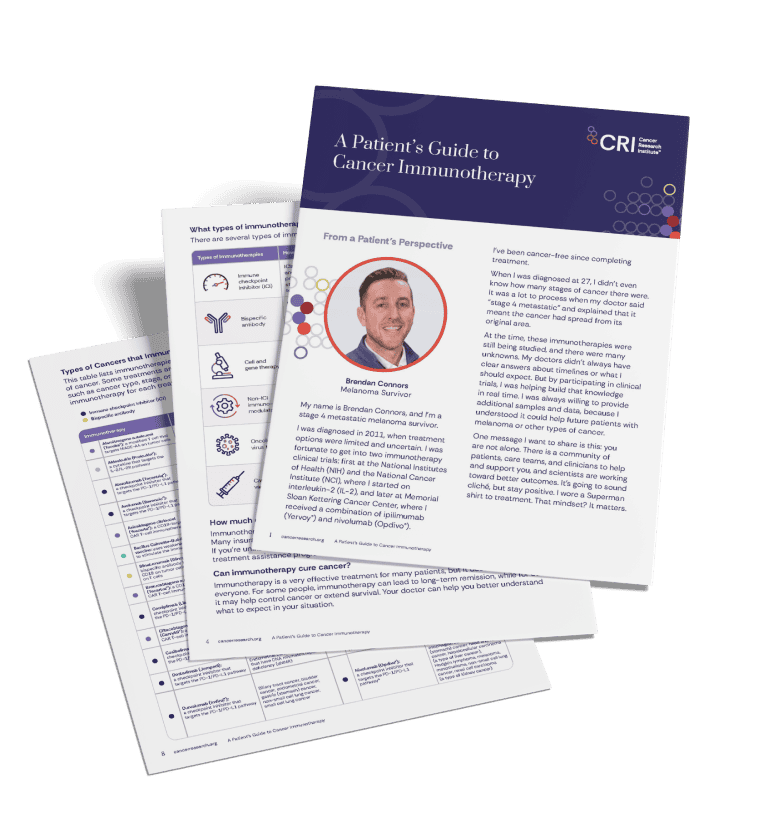
A Patient’s Guide to Cancer Immunotherapy
Your path to understanding immunotherapy — guided by survivors, experts, and hope
Find a Clinical Trial Near You

Sources
Key Statistics for Lung Cancer
(2026) American Cancer Society
Global Cancer Statistics 2024
(2026) CA: A Cancer Journal for Clinicians
Cancer Stat Facts: Lung and Bronchus Cancer
(2026) National Cancer Institute (SEER)
Lung Cancer Survival Rates
(2025) American Cancer Society
Cancer Facts & Figures 2026
(2026) American Cancer Society
Cancer Statistics, 2026
(2026) CA: A Cancer Journal for Clinicians
Trachea, Bronchus, and Lung Fact Sheet
(2024) GLOBOCAN, International Agency for Research on Cancer
Lung Cancer: Screening
(2021) U.S. Preventive Services Task Force
Health Risk of Radon
(2026) U.S. Environmental Protection Agency
FDA Approves Neoadjuvant/Adjuvant Pembrolizumab for Resectable Non-Small Cell Lung Cancer
(2023) U.S. FDA
FDA Approves Neoadjuvant/Adjuvant Nivolumab for Resectable Non-Small Cell Lung Cancer
(2024) U.S. FDA
FDA Approves Durvalumab for Limited-Stage Small Cell Lung Cancer
(2024) U.S. FDA
FDA Grants Traditional Approval to Tarlatamab-dlle for Extensive Stage Small Cell Lung Cancer
(2025) U.S. FDA
Oncology (Cancer)/Hematologic Malignancies Approval Notifications
(2014–2026) U.S. FDA
Neoadjuvant PD-1 Blockade in Resectable Lung Cancer
(2018) New England Journal of Medicine
Mutational Landscape Determines Sensitivity to PD-1 Blockade in Non-Small Cell Lung Cancer
(2015) Science
Join CRI in Shaping the Future of Immunotherapy
Support the pioneering work of CRI in advancing cancer research.