
Contributing author: Robbie Majzner, MD
Over the past several decades, treatment for childhood cancer has improved dramatically. Today, many children diagnosed with cancer will survive their disease.
But that progress does not tell the whole story.
Some childhood cancers remain extremely difficult to treat. Even when treatment is successful, intensive therapies can leave survivors with health effects that last for decades. And many of the advances transforming cancer treatment for adults cannot simply be applied to children.
That is because childhood cancers are not just adult cancers occurring in younger patients. Their biology can be fundamentally different.
For Childhood Cancer Awareness Month, the Cancer Research Institute (CRI) spoke with Robbie Majzner, MD, a pediatric oncologist, physician-scientist, and a CRI Lloyd J. Old STAR whose research is exploring how immunotherapy could help address some of the biggest challenges in treating childhood cancers.
Why Is Childhood Cancer Different?
Childhood cancer is not a single disease. It includes leukemias, brain tumors, neuroblastoma, kidney tumors, sarcomas, and many other cancers — some of which affect only a small number of children each year.
Their underlying biology can also differ from cancers that develop in adults.
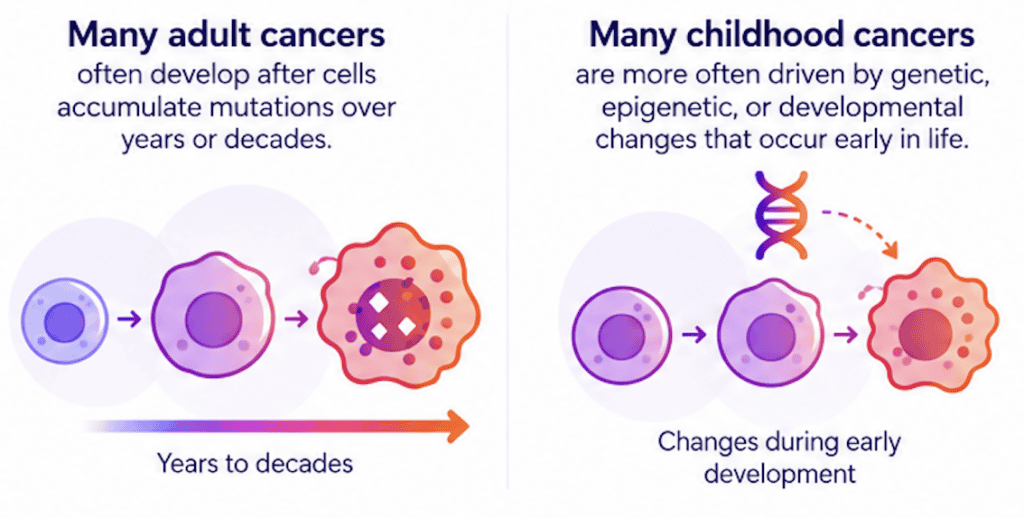
While many adult cancers arise after cells accumulate mutations over years or decades, childhood cancers are more often driven by genetic, epigenetic, or developmental changes. As Dr. Majzner explained, many are essentially “a product of aberrant development” — something goes wrong as cells move through their normal developmental pathways.
Childhood cancers are also remarkably diverse. A leukemia is very different from a brain tumor or sarcoma, and even those categories contain many distinct types of cancer.
That combination of unique biology, tremendous diversity, and small patient populations creates challenges for developing treatments — including immunotherapies.
Why Does Immunotherapy Work Differently in Children?
Immune checkpoint inhibitors have transformed treatment for several adult cancers. These therapies remove “brakes” that can prevent T cells from attacking cancer, strengthening an immune response that is already there.
But many pediatric cancers have relatively few mutations, giving the immune system fewer abnormal features to recognize. If T cells are not responding strongly to the tumor in the first place, simply releasing the brakes may not be enough.
“It’s not a trickle-down approach that we can just take what works in adult oncology and use it in pediatrics,” Dr. Majzner said. “They have a fundamentally different immunobiology.”
Instead, researchers are investigating ways to actively direct the immune system toward childhood cancers.
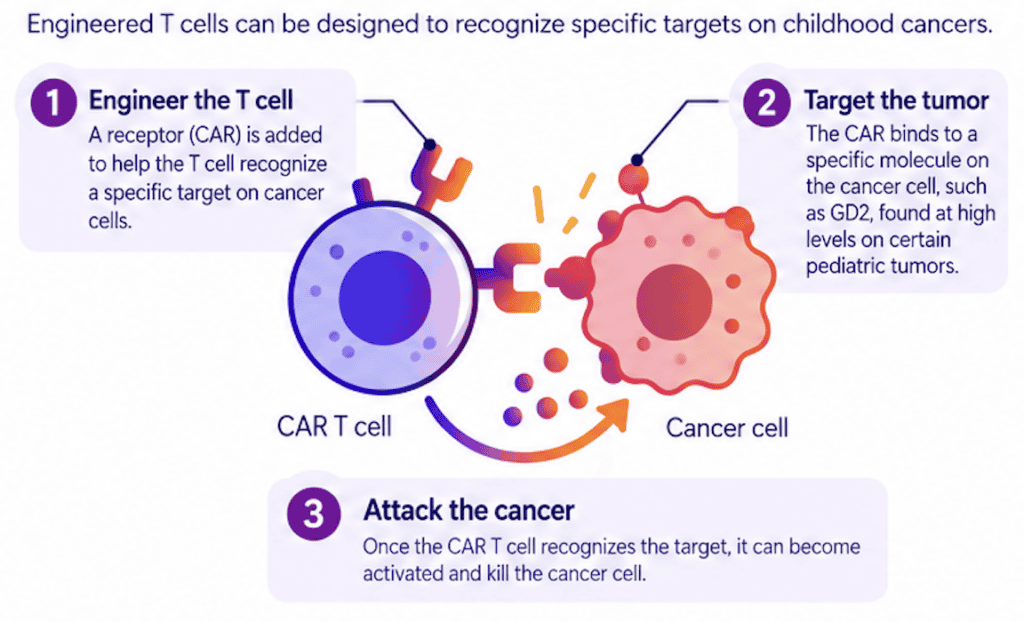
One approach is CAR T-cell therapy, which engineers a patient’s T cells with a receptor designed to recognize a specific target on cancer cells. Dr. Majzner describes this strategy as creating a “synthetic immune response” — redirecting the killing power of T cells toward tumors they might otherwise fail to recognize.
CAR T-cell therapy has already changed treatment for some children with leukemia. Now, researchers are working to extend that success to solid tumors.
Building Better CAR T Cells for Childhood Cancers
Dr. Majzner’s laboratory studies both sides of that challenge: the engineered immune cell and the cancer it needs to recognize.
His team investigates how signals move through CAR T cells after they encounter cancer, using that knowledge to design new receptors that could make the cells more effective and better able to distinguish tumors from healthy tissue. The researchers also study potential targets on pediatric tumors, including why those targets appear and what happens when only some cancer cells express them.
One example involves GD2, a molecule found at high levels on certain pediatric tumors.
While at Stanford University, Dr. Majzner and colleagues helped show that the biology of diffuse midline glioma (DMG), an aggressive pediatric brain tumor, drives the expression of GD2. That discovery helped provide the rationale for testing GD2-targeted CAR T cells in patients.
Early clinical research has since shown encouraging signs of activity, including long-term responses in some patients and improvements in neurological symptoms in others. Dr. Majzner’s current research is building on lessons from that work to develop new receptor designs and investigate how cell therapy could benefit more patients with solid tumors.
Making Room for High-Risk Ideas
As a CRI Lloyd J. Old STAR, Dr. Majzner has flexible funding to pursue some of the early scientific questions that could lead to those next advances.
His laboratory is exploring fundamental T-cell signaling and developing new technologies — work that can be difficult to fund when researchers do not yet know exactly where an idea will lead, especially in rarer cancers.
“If you just shut down all high-risk ideas, we will never get new technologies,” Dr. Majzner said.
His own research illustrates why. The receptors his team engineers today rely partly on basic discoveries made decades ago by scientists studying how T cells signal — research conducted without knowing exactly how that knowledge might eventually be used.

What Comes Next for Childhood Cancer Immunotherapy?
For Dr. Majzner, one of the most exciting possibilities is bringing the power of cell therapy to more solid tumors. Researchers are beginning to see signs that these approaches can work for some patients, while learning more about how to make those responses stronger and more consistent.
Scientists are also exploring new ways to make cell therapy easier to produce and deliver. One emerging approach, known as in vivo CAR T-cell therapy, aims to generate CAR T cells directly inside the body rather than engineering each patient’s cells in a laboratory. Other treatments, including antibody-based therapies and antibody-drug conjugates, are also beginning to reach pediatric oncology.
Together, these approaches reflect a larger goal: not simply adapting treatments developed for adults, but designing therapies around the unique biology of childhood cancers.
Pediatric oncology has already demonstrated what sustained research can accomplish. But for children whose cancers still have too few treatment options — and for survivors who may live with the effects of treatment for decades — there is more work ahead.
The next chapter of childhood cancer research is not only about helping more children survive. It is about developing treatments that can give them more healthy years afterward.