

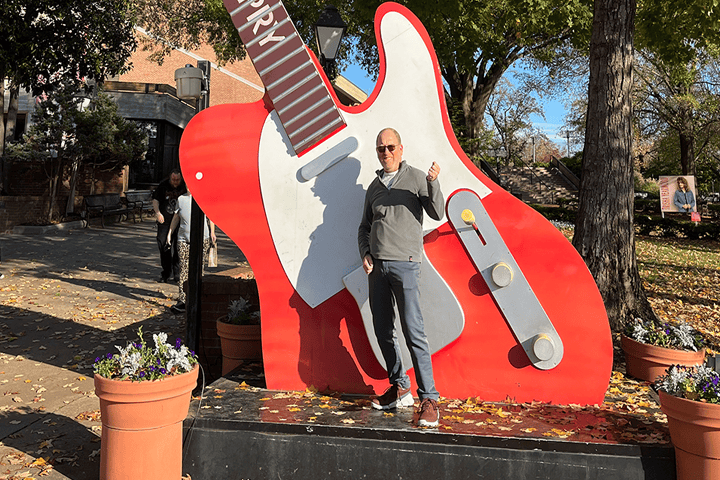
After exhausting nearly every treatment option for stage 4 colorectal cancer, Gordon Levine was preparing to put his affairs in order. A second opinion — and a new immunotherapy combination — changed everything. Today, Gordon is cancer-free, living fully, and advocating to ensure more patients have the same chance he did.
Want to help change lives through cancer immunotherapy?
The Journey Through Cancer
In November 2014, Gordon Levine was diagnosed with stage 3 colon cancer. Surgery and chemotherapy brought him into remission — but only briefly. Within a year, his cancer returned.
What followed was a grueling cycle of invasive surgeries, temporary remissions, and crushing recurrences. By January 2018, Gordon’s cancer had progressed to stage 4, having spread to his abdomen, liver, lungs, and bones. The tumors in his spine and hip caused what he describes as “excruciating pain.”
His options were running out.
“You go through this process where you’re curable, and then you’re operable, and then you’re treatable — and then you’re none of those things.”
He enrolled in a clinical trial combining the immunotherapy pembrolizumab (Keytruda®) with the targeted therapy binimetinib (Mektovi®). But his cancer continued to progress, and severe side effects forced him off the trial. His doctors considered it a failure.
He was placed on lonsurf, a later-line therapy designed not to reverse metastatic colorectal cancer, but to slow it down. The treatment was toxic. Despite his ever present optimism, Gordon’s outlook was grim.
Still, he wasn’t ready to give up.
Seeking a second opinion changed everything. A new oncologist reviewed his case and saw something others had not: Gordon hadn’t “failed” immunotherapy. His adverse reaction appeared to be an overactive immune response — a known side-effect of these treatments. With updated genetic testing revealing promising markers, they decided to try immunotherapy one last time.
His doctors back home were skeptical.
“I didn’t really have many options,” Gordon recalls. “I had this, or I had to put my affairs in order.”
📢 Gordon has a simple message: stop avoiding the conversation.
Colon cancer is preventable and treatable when caught early.
Get screened.
A Turning Point
Gordon began traveling from his home in Canada to San Diego to receive a combination of two immunotherapies: ipilimumab (Yervoy®) and nivolumab (Opdivo®).
After his third treatment, something remarkable happened. The pain that had dominated his life for years began to ease.
After just four doses, his oncologist called and insisted they meet at the clinic – it was a Friday. Gordon’s doctor shared the stunning news:
“The tumors are melting away.”
It was a dramatic reversal. Gordon went from barely being able to walk to forgetting to take his pain medication because he no longer needed it. Even while continuing treatment, he was able to enjoy simple but extraordinary experiences — lunches out, visits to the zoo, walks on the beach.
In 2021, about a year after completing treatment, Gordon underwent surgery to remove the last remaining trace of cancer. What doctors found astonished them: the disease had been reduced to one small portion of his colon.
The immunotherapy had worked.

I just thought of myself as somebody fighting to stay alive. But I’ve realized it’s important for us to be living survivors of this disease — to show that these outcomes are possible.
The Cost – and the Comeback
Immunotherapy transformed Gordon’s prognosis — but it wasn’t easy.
“Immunotherapy does miraculous things,” he says. “But it’s not easy. Nothing is a walk in the park.”
During treatment, his entire colon was removed, leaving him with a permanent ostomy. He developed adrenal failure and will require lifelong steroids. Years of escalating opioid doses for cancer pain left him facing withdrawal symptoms even after the pain subsided — a complication he now speaks openly about to raise awareness for other patients.
“It’s important for them to know.”
Yet not a single step of Gordon’s cancer journey has slowed him down – and in fact, he’s picked up the pace.
He has traveled on an African safari — ostomy bag and all. He has regained strength, put weight back on, and returned to the activities he loves. Today, he plays music, swims, travels, and plays a lot of pickleball.
“I take every day as a gift.”
Living Proof
After his cancer journey, Gordon retired from his law career and turned his energy toward advocacy. He has partnered with organizations — including CRI’s immunotherapy patient summits — to support other patients and share his story.
He is deeply passionate about research, too. Having met scientists whose work contributed to the therapies that saved his life, he understands the extraordinary effort behind every breakthrough.
It’s really, really crucial to make sure that the brightest, best scientists are focusing their efforts on treatments that will help people prolong our lives and maybe even cure people that were incurable.
Gordon pauses before using that word — cure.
“You don’t want to ever talk about curing. But people are living long enough that they start to use that word for people like me — people who were effectively terminal. It’s astounding.”
Gordon Levine was once preparing to tell his family goodbye.
Today, he is living proof of what immunotherapy — and relentless determination — can make possible.