
Contributing author: Blood Cancer United
Some cancers and cancer treatments can affect fertility. Researchers are gathering better data to understand whether CAR T-cell therapy affects fertility, and which patients, if any, may be most affected.
September is Blood Cancer Awareness Month, a time to recognize not only advances in treating blood cancers, but also the issues that increasingly matter as more people live longer after treatment.
For many people facing cancer, the first question is: Will it work? But treatment is only part of the picture. For younger patients in particular, concerns about life afterward may include whether they will be able to have biological children.
A study led by researchers at Blood Cancer United, Moffitt Cancer Center, and University of Florida Health is helping address those concerns by learning directly from adults who have received a cancer treatment called CAR T-cell therapy.
Take the survey
What is CAR T-cell therapy?
Chimeric antigen receptor (CAR) T-cell therapy is a type of immunotherapy that modifies a patient’s own immune cells to better recognize and attack cancer.
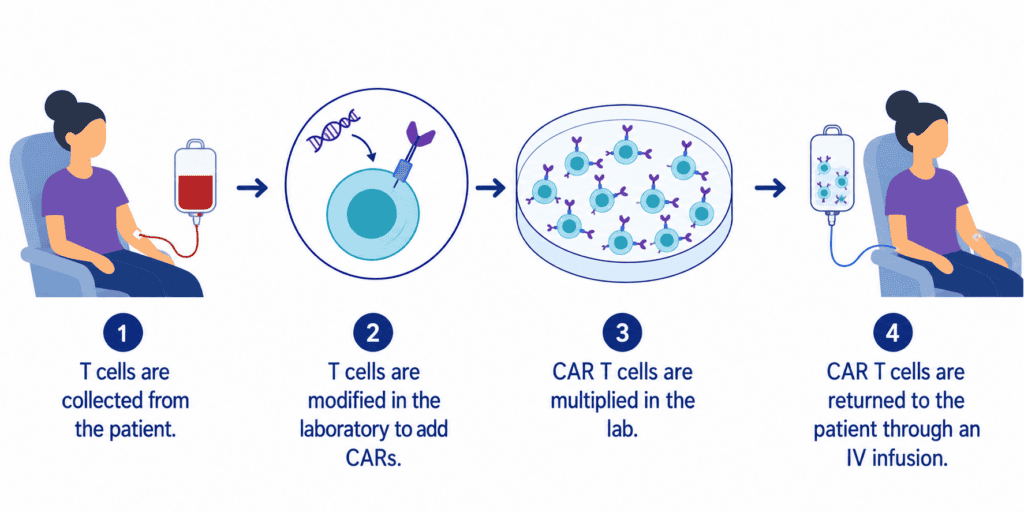
T cells, a type of white blood cell, are collected from the patient and genetically modified in a laboratory to add a chimeric antigen receptor, or CAR. This receptor helps the T cells recognize a specific target on cancer cells. The engineered cells are multiplied and returned to the patient, where they can find and attack cells carrying that target.
CAR T-cell therapy grew out of decades of research. A major breakthrough came in 2010, when research led by CRI Scientific Advisory Member Carl June, MD, resulted in CAR T cells that achieved remission in patients with refractory leukemia. This helped pave the way for the first CAR T-cell therapy approved by the FDA in 2017. Today, several CAR T-cell treatments are available for certain leukemias, lymphomas, and multiple myeloma.
Learn more about immunotherapy
Explore CRI’s timeline of cancer immunotherapy history
Why don’t we already know how CAR T affects fertility?
The first people treated with CAR T cells generally had aggressive blood cancers that had returned or stopped responding to other therapies. Many had already received several treatments, and early studies appropriately focused on whether CAR T cells could be given safely and help patients with few remaining options.
That history also makes fertility difficult to study.
Many CAR T recipients have previously received chemotherapy, radiation, and stem cell transplantation, treatments already known to affect fertility in some patients. Patients also typically receive a brief course of chemotherapy called lymphodepletion before CAR T-cell infusion to help the engineered cells expand.
Learn about the differences between chemotherapy and immunotherapy
As a result, if someone experiences fertility problems after CAR T-cell therapy, it can be difficult to determine whether CAR T itself played a role or whether the effects reflect earlier cancer treatments, age, underlying disease, or several factors together.
What is the new study finding?
To improve our understanding, researchers at Blood Cancer United, Moffitt Cancer Center, and University of Florida Health developed a patient-facing survey to collect fertility experiences directly from adults who received CAR T-cell therapy for blood cancer.
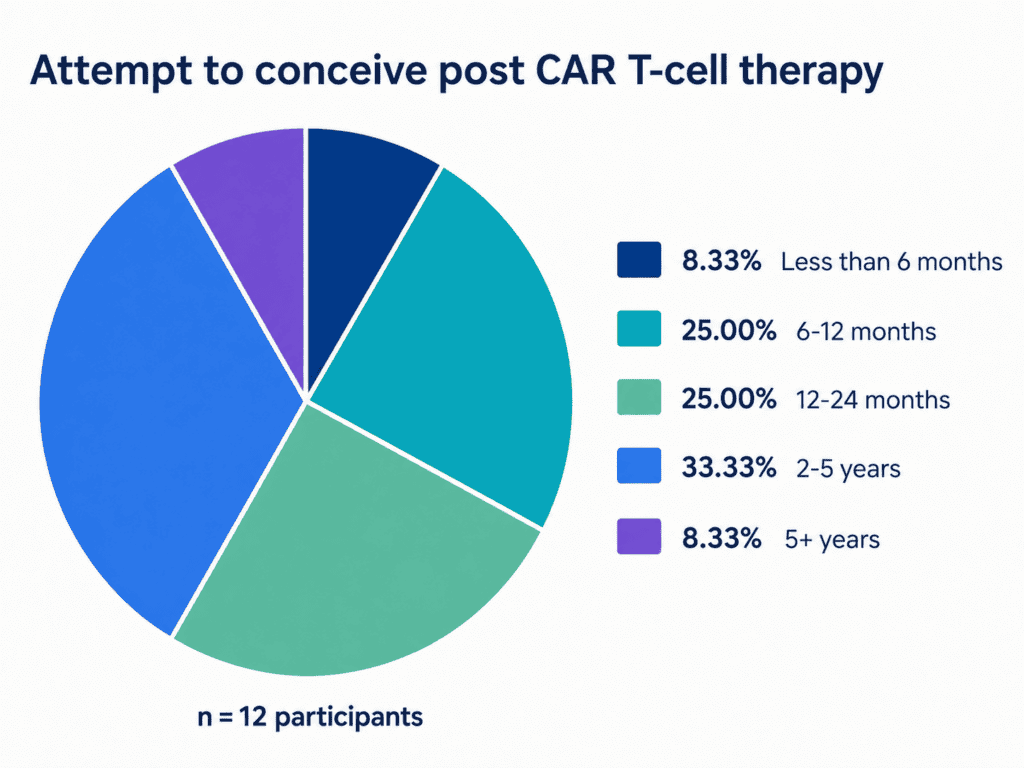
Preliminary results from 106 respondents provide an important first look. Thirty-two said they wanted children after CAR T-cell therapy, and 12 had attempted to conceive. Six reported a pregnancy (four female respondents and two partners of male respondents).
At the time of the analysis, three pregnancies had resulted in live births and three were ongoing. None of the six reported using assisted reproductive technology.
The results do not yet tell us whether CAR T-cell therapy affects fertility, how often fertility may be affected, or who might be most at risk. They do show that pregnancies and live births have occurred after CAR T-cell therapy.

These early findings are encouraging, but they also highlight how much we still need to learn. Our goal is to give patients and their care teams better information about fertility after CAR T-cell therapy so they can have informed conversations about treatment, survivorship, and their plans for the future.
Nina Logan, MD
Senior Director, Research & Clinical Programs
Blood Cancer Unite
What can we learn from CAR T therapy beyond cancer?
CAR T-cell therapies are also being studied for autoimmune diseases such as lupus. Because these patients have different diseases and treatment histories, their experiences may offer another window into the potential effects of CAR T therapy.
In a 2026 report, researchers described 14 pregnancies among 13 patients who had previously received CAR T-cell therapy for autoimmune disease. Eight healthy infants had been born at the time of publication.
These findings are still small in number and cannot tell us what will happen for people treated for cancer. But together with emerging cancer-survivor data, they add to what researchers are learning about reproductive health after CAR T-cell therapy.
Why does this research matter?
If research can clarify whether CAR T-cell therapy affects fertility, clinicians can give patients clearer guidance about potential risks, fertility preservation, and family-building options before and after treatment.
The CAR T-Cell Therapy and Fertility Survey is part of that effort. Researchers plan to continue examining patient experiences, laboratory measures related to fertility, and fertility outcomes in additional groups receiving CAR T-cell therapy.
Have you received CAR T-cell therapy for blood cancer? Adults age 18 and older can learn more about participating in the CAR-T Fertility Survey.
By sharing their experiences, patients can help researchers build the evidence needed to better inform cancer treatment and life after it.
Read about Sonia’s experience with CAR T-cell therapy
Read about Kristin’s experience with CAR T-cell therapy
Sources
Pediatric cancer immunotherapy and potential for impact on fertility: A need for evidence-based guidance
Transplant Cell Ther, 2024
Fertility outcomes following CAR T-cell therapy: Results from a patient-facing survey
Tandem Meetings | Transplantation & Cellular Therapy Meetings of ASTCT and CIBMTR, 2026
Pregnancies in patients with autoimmune disease receiving CAR T-cell therapy
N Engl J Med, 2026
Approved Cellular and Gene Therapy Products
U.S. Food and Drug Administration, 2026
Disclaimer: We’re sharing this research opportunity for informational purposes only. CRI does not endorse or recommend the study, participation in the study, or the study sponsor. CRI is not involved in conducting the study or determining who is eligible to participate. If you are interested in learning more, please contact the study team directly using the information provided.