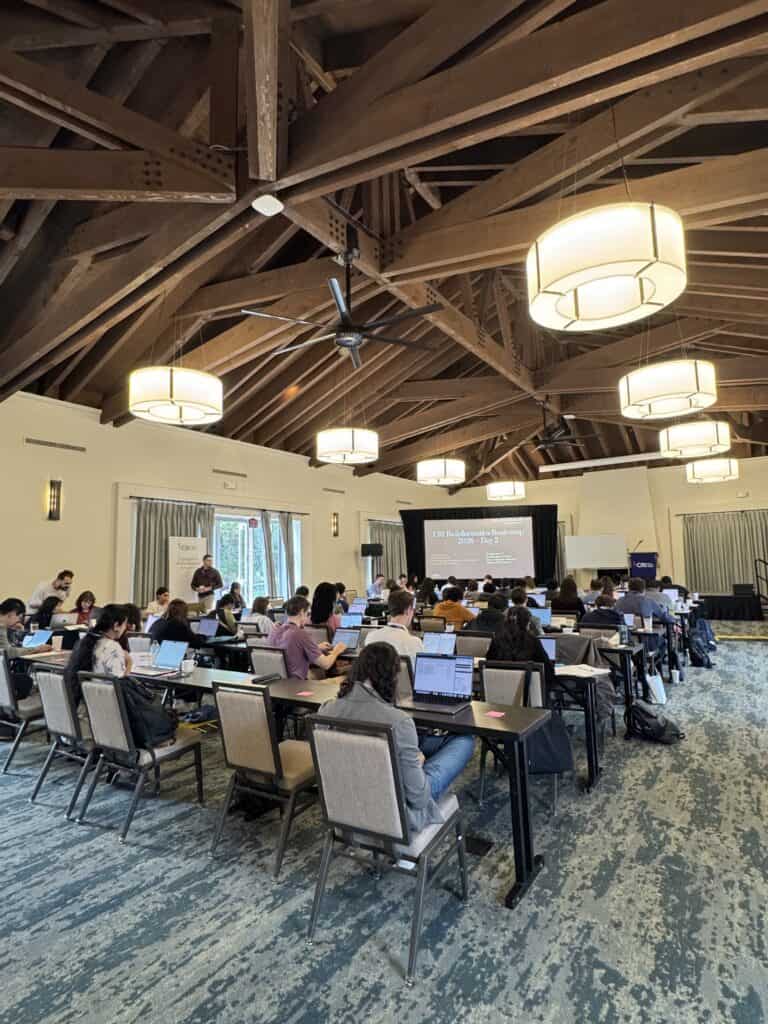
During May 16–22, 2026, more than 50 fellows and students gathered at the La Cantera Resort in San Antonio, Texas, for a week of intensive, hands-on instruction at the third annual Cancer Research Institute (CRI) Bioinformatics Bootcamp.
CRI’s Bioinformatics Bootcamp is an immersive training program designed to equip early-career scientists with the computational skills needed to navigate the rapidly evolving landscape of cancer immunotherapy research. The program aims to bridge the gap between experimental biology and data science, empowering researchers to confidently analyze and interpret complex biological datasets.
As cancer research becomes increasingly data-driven, scientists are expected not only to generate big datasets but also to extract meaningful biological insights from them. The Bioinformatics Bootcamp addresses this critical need by providing practical training in key bioinformatics approaches used across immunology and oncology research, including next-generation sequencing analysis, single-cell technologies, data visualization, and computational workflows.
“The Bootcamp is important because it’s really bridging the gap across two fields of the wet lab and the dry lab. As technologies are evolving, we’re generating large data sets, and we need computational tools to be able to understand more complex pictures, more complex data sets, and make more complex discoveries,” said Christie Chang, teaching assistant (TA) at the Bootcamp. “We’re only learning about cancer because we were able to extend lifespans, and we want to keep extending them. Technology advances so that we can live longer.”
Bootcamp attendees have the opportunity to learn from leaders in the field while also working one-on-one with faculty on their own datasets. This year’s faculty included five bioinformatics experts, four of whom have participated in CRI’s Bootcamp since its inception. Together, they have helped shape and refine the curriculum to ensure participants are learning the most relevant and up-to-date tools as the field continues to evolve. In addition, five teaching assistants with expertise in bioinformatics and computational biology supported participants throughout the hands-on analyses.
“When we started the bioinformatics bootcamp just three years ago, we really focused on the basics and the fundamentals of programming,” said Katie Campbell, PhD, one of the faculty members at the Bootcamp. “With the rapid pace of technology, there’s a rapid pace of the tools available to analyze. We have to think about how we accelerate not just the discovery but the analysis, the everyday, without taking away the necessary thought processes that have to be intrinsic to the fellows as they take on this research.”
What makes the Bootcamp especially impactful is its emphasis on accessibility, collaboration, and real-world application. Participants come from diverse scientific backgrounds — many with limited formal computational training — and gain direct experience working alongside expert faculty and peers in a supportive learning environment. By demystifying bioinformatics and making advanced analytical tools more approachable, the program helps expand computational literacy across the cancer research community.
This year, CRI introduced several new topic-focused sessions to better serve attendees. Lunch-hour roundtables, capped at 18 participants, encouraged engaging discussions on subjects such as complex experimental design, computational career pathways, grant planning for bioinformatics, and coding reproducibility. Additional evening sessions explored timely topics, including artificial intelligence in research and advanced Python coding techniques. Together, these sessions were thoughtfully curated to enrich the participant experience and provide practical tools and ideas attendees can apply to their own work.
“In today’s time, a lot of science is moving towards big data,” said Maryam Pourmaleki, PhD, TA at the Bootcamp. Scientists who have phenomenal training in wet lab now need to analyze bigger multimodal data they’re generating, and the Bootcamp is giving those scientists the necessary tools to work with big data.”
The Bootcamp also reflects CRI’s broader commitment to accelerating progress in immunotherapy through education, innovation, and interdisciplinary collaboration. By training researchers to better harness complex datasets, the program helps drive discoveries that may ultimately improve how cancers are understood, diagnosed, and treated.
Beyond technical skill-building, the Bootcamp fosters a growing network of scientists united by a shared goal: advancing the future of cancer immunotherapy through data-informed research. Participants leave not only with new analytical capabilities but also with greater confidence in integrating bioinformatics into their own scientific work and collaborations.
“It’s super important to zoom out from your own research,” said Tara Muijlwijk, PhD, attendee and CRI Dr. Keith Landesman Memorial Fellow. “The Bootcamp is really a great way to zoom out and to think about, okay, what am I doing, why am I doing this, and also to connect with other people, which is super important in research.”
More than just a training program, the CRI Bioinformatics Bootcamp represents an investment in the future of cancer research. By fostering curiosity, collaboration, and computational confidence, the program equips emerging scientists to push the boundaries of discovery and contribute to the next generation of breakthroughs in cancer immunotherapy.

It’s just such an amazing opportunity offered by CRI to really help learn all of the informatics skills more systematically, rather than just chatting with an AI engine.
– Jia Yu (Jennifer) Ye, PhD, Bootcamp attendee and CRI Immunoinformatics Postdoctoral Fellow