
Immunotherapy for Colorectal Cancer
Learn how immunotherapy helps treat colon cancer and rectal cancer
What is Colorectal Cancer?
Colorectal cancer is the third most commonly diagnosed cancer worldwide, with approximately 1.9 million new cases and over 900,000 deaths recorded globally in 2022. In the U.S., an estimated 158,850 new cases and 55,230 deaths are expected in 2026.
Colorectal Cancer Statistics
Worldwide
3rd
Most common cancer
1.9M
New cases diagnosed each year
U.S.-Specific Statistics
158,850
New cases diagnosed each year
55,230
Deaths expected in 2026
65%
Five-year survival rate
Colorectal cancer includes both colon cancer and rectal cancer, which begin in the lining of the colon or rectum, respectively. Over 95% of colorectal cancers develop from adenocarcinomas, uncontrolled growths in the lining of glandular organs. The disease usually develops slowly, often starting as noncancerous growths called polyps that can progress to cancer over time if not detected and removed. These cancers can spread to nearby lymph nodes and distant organs if not detected and treated early.
Colorectal cancer risk is influenced by a combination of factors, including genetics. About 5-10% of colorectal cancers are associated with inherited genetic mutations.
One example is Lynch syndrome, a hereditary condition that affects how cells repair damaged DNA and is responsible for an estimated 5,000 new colorectal cancer cases each year in the U.S.
Cancers linked to Lynch syndrome often have mutations in genes that regulate DNA repair known as mismatch repair deficiency (dMMR), meaning the cancer has difficulty repairing damaged DNA. These tumors frequently show high microsatellite instability (MSI-H), meaning they accumulate many DNA errors over time.
Tumors with these DNA-repair-related biomarkers, such as dMMR or MSI-H, often have distinct tumor features that make them more responsive to immunotherapy. Ongoing research is expanding the role of immunotherapy and exploring how immune-based treatments can help more people with colorectal cancer.
What is Colorectal Cancer Screening, and How Is Colorectal Cancer Detected?
Colorectal cancer screening can help detect cancer early, before symptoms appear, when treatment is most effective. Screening can also identify precancerous growths called polyps, which can be removed to prevent cancer from developing.
Common types of colorectal cancer screening:
- Colonoscopy: A procedure that allows doctors to examine your entire colon and rectum using a flexible camera. Abnormal tissue and polyps can be removed during the exam.
- Stool-based tests: Tests such as the fecal immunochemical test (FIT) and stool DNA tests check for hidden blood or abnormal DNA in your stool or poop that may indicate cancer.
- Flexible sigmoidoscopy: A procedure that examines the lower part of your colon and rectum.
- CT colonography (virtual colonoscopy): A specialized imaging test that uses CT scans to look for polyps or cancer in your colon.
Despite advances in screening, colorectal cancer remains a major health concern. Only about 32% of colorectal cancers are diagnosed at an early stage, when the five-year survival rate is approximately 90%. Once the cancer spreads to distant organs, survival rates drop sharply, highlighting the importance of regular screening and early detection.
Colorectal cancer rates have also been rising in younger adults in recent years, making awareness and timely screening especially important. People with a family history of colorectal cancer, a personal history of polyps, inflammatory bowel disease, or genetic conditions such as Lynch syndrome may need to begin screening earlier or be screened more frequently.
Below are general colorectal cancer screening guidelines for adults at average risk, based on recommendations from the U.S. Preventive Services Task Force:
| AGE | Colorectal Cancer Screening Guidelines |
|---|---|
| 45-75 years | Screen for colorectal cancer using one of the following options:
|
| 76-85+ years | Screening decisions should be individualized based on overall health, prior screening history, and discussion with a health care team. |
Talk to your health care team about which screening option and schedule is right for you.
What Are The Symptoms of Colorectal Cancer?
Colorectal cancer often has no symptoms in its early stages. When symptoms do occur, they can be mild and may overlap with other, less serious conditions — another reason why regular screening is so important.
Possible symptoms of colorectal cancer include:
- Changes in bowel habits (such as diarrhea, constipation, or narrowing of the stool)
- Blood in the stool or rectal bleeding
- Persistent abdominal discomfort (cramps, gas, or pain)
- Unexplained weight loss
- Fatigue or weakness
If you are experiencing ongoing or unusual symptoms, talk to your health care team.
Can Colorectal Cancer Be Prevented?
Colon and rectal cancers can often be prevented or detected early through regular screening. Screening can find cancer before symptoms appear and can prevent cancer by identifying and removing precancerous polyps.
Making healthy lifestyle choices may also help lower your risk. Staying physically active, maintaining a healthy weight, eating a balanced diet, avoiding tobacco, and limiting alcohol intake can all reduce your risk for colorectal cancer.
If you have a family history of colorectal cancer or genetic condition such as Lynch syndrome, you may need earlier or more frequent screening. Talk with your health care team about the best prevention and screening plan for you.
How Is Colorectal Cancer Treated?
Colorectal cancer can be treated in several ways, depending on the stage of disease, tumor location, tumor characteristics, and a patient’s overall health. Standard treatment options include surgery, chemotherapy, radiation therapy, targeted therapy, and immunotherapy. Immunotherapy is a standard treatment option for some patients, particularly those with advanced disease and specific tumor features.
Immunotherapies Used to Treat Colorectal Cancer
Immunotherapy is a type of cancer treatment that uses your body’s immune system to recognize and attack cancer cells. It works by helping your immune cells overcome cancer’s defenses, allowing them to better identify and destroy tumors.
In colorectal cancer, immune checkpoint inhibitors (ICIs), a type of immunotherapy that block immune checkpoints such as PD-1, PD-L1, or CTLA-4, are most effective for many patients with tumors that are MSI-H or dMMR. These tumors produce many abnormal proteins that make them easier for your immune system to recognize.
ICIs approved for colorectal cancer include:
- Pembrolizumab (Keytruda®): Approved as a first-line treatment for patients with unresectable (meaning the tumor cannot be safely removed with surgery) or metastatic colorectal cancer that is MSI-H or dMMR. It is a PD-1 immune checkpoint inhibitor.
- Nivolumab (Opdivo®): Approved for patients with MSI-H or dMMR metastatic colorectal cancer that has progressed after chemotherapy. It may be used alone or in combination with ipilimumab. It is a PD-1 immune checkpoint inhibitor.
- Nivolumab + Ipilimumab (Yervoy®): Approved for certain patients with MSI-H or dMMR metastatic colorectal cancer. This combination targets PD-1 and CTLA-4 immune checkpoints.
- Dostarlimab (Jemperli®): Approved for patients with dMMR recurrent or advanced solid tumors, including colorectal cancer, when disease has progressed after prior treatment and no satisfactory alternatives exist. It is a PD-1 immune checkpoint inhibitor.
For patients whose tumors do not have MSI-H or dMMR features, immunotherapy is generally not yet a standard treatment, but clinical trials are actively exploring new immune-based approaches.
Targeted Therapies Used to Treat Colorectal Cancer
Targeted therapies block specific pathways that cancer cells use to grow. Unlike immunotherapies, these agents do not directly activate your immune system, but are commonly used alongside chemotherapy or other treatments for colorectal cancer. These include:
- Bevacizumab (Avastin®): Commonly used in combination with chemotherapy for patients with advanced colorectal cancer. It is a monoclonal antibody that targets the VEGF/VEGFR pathway to block tumor blood vessel growth.
- Cetuximab (Erbitux®): Approved for certain patients with advanced colorectal cancer whose tumors do not have specific RAS gene mutations. It is a monoclonal antibody that targets the EGFR pathway.
- Panitumumab (Vectibix®): Approved for select patients with advanced colorectal cancer whose tumors do not have RAS gene mutations. It is an EGFR-targeting monoclonal antibody.
- Ramucirumab (Cyramza®): Approved in combination with chemotherapy for some patients with advanced colorectal cancer. It is a monoclonal antibody that targets the VEGF/VEGFR2 pathway and inhibits tumor blood vessel growth.
Are There Clinical Trials for Patients with Colorectal Cancer?
If standard treatments for patients with colorectal cancer haven’t worked or are not available, clinical trials may offer access to promising new therapies. Clinical research is actively exploring several types of immunotherapy and immune-based strategies for colorectal cancer, particularly for patients whose tumors do not have MSI-H or dMMR features:

Immune checkpoint inhibitors (ICIs) help release your immune system’s “brakes”, allowing it to better recognize and attack cancer. While these therapies are already effective for patients whose tumors are MSI-H/ddMR, researchers are testing new ICI targets and combination approaches to extend benefits to more patients.

Therapeutic cancer vaccines are designed to train your immune system to recognize proteins expressed by colorectal cancer cells. These vaccines are being studied alone and in combination with other immunotherapies to improve immune responses against tumors.

Adoptive cell therapies involve expanding or modifying your own immune cells to fight cancer. Approaches such as tumor-infiltrating lymphocyte (TIL) therapy and engineered T-cell therapies are being evaluated in clinical trials for patients with advanced colorectal cancer.

Oncolytic virus therapies use modified viruses to infect and destroy cancer cells while activating your immune system. Several virus-based therapies are being tested in colorectal cancer, often in combination with checkpoint inhibitors.

Combination approaches are being studied to improve treatment outcomes by pairing immunotherapies with chemotherapy, radiation, or other immune-based treatments.
How Is CRI Advancing Colorectal Cancer Research?
CRI supports colon and rectal cancer research from basic laboratory discovery to clinical trials. Our funding has helped reveal how the immune system shapes colorectal tumors, identify biomarkers, and advance new immunotherapy strategies.
A major turning point came in 1998, when Haruo Ohtani, MD, showed that tumors rich in T cells were linked to better survival in colon cancer. His work, recognized with CRI’s William B. Coley Award and shared with Jérôme Galon, PhD, and Wolf Hervé Fridman, MD, PhD, provided foundational evidence that the immune system plays a critical role in colorectal cancer outcomes and paved the way for the Immunoscore, a tool that classifies tumors based on immune cell infiltration and is now being validated in more than 20 countries.
Today, CRI is funding scientists tackling the fundamental challenges that have made most colorectal cancers resistant to immunotherapy, including:
- CRI Irvington Postdoctoral Fellow Jesse Boumelha, PhD, at Icahn School of Medicine at Mount Sinai, is studying how certain immune cells can protect colorectal tumors from attack. His work aims to understand why some patients do not respond to immunotherapy and how to make these treatments work better.
- CRI Irvington Postdoctoral Fellow Parasvi Patel, PhD, at Massachusetts General Hospital, is examining how drugs that target KRAS gene mutations, which are found in about 40% of colorectal cancers, change the tumor’s immune environment. Her goal is to find the best ways to combine these drugs with immunotherapy to improve patient outcomes.
- CRI Tech Impact Award Investigator Karin Pelka, PhD, at The J. David Gladstone Institutes, is mapping how cancer cells and immune cells interact inside colorectal tumors. By understanding these interactions, she hopes to identify new strategies to overcome resistance to immunotherapy.
- CRI CLIP Investigator Nicolas Vabret, PhD, at Icahn School of Medicine at Mount Sinai, discovered that U.S. FDA approved antiviral drug lamivudine can reduce tumor-promoting inflammation in colorectal cancer and is now leading a clinical trial testing it together with checkpoint inhibitors to improve treatment responses.

“Colorectal cancer patients with liver metastases have never really benefited from classical immunotherapies, and it’s incredibly common, so it’s a huge unmet medical need.”
Jesse Boumelha, PhD
Icahn School of Medicine at Mount Sinai, CRI Irvington Postdoctoral Fellow
Last updated
Colorectal Cancer Statistics
Worldwide
3rd
Most common cancer
1.9M
New cases diagnosed each year
U.S.-Specific Statistics
158,850
New cases diagnosed each year
55,230
Deaths expected in 2026
65%
Five-year survival rate
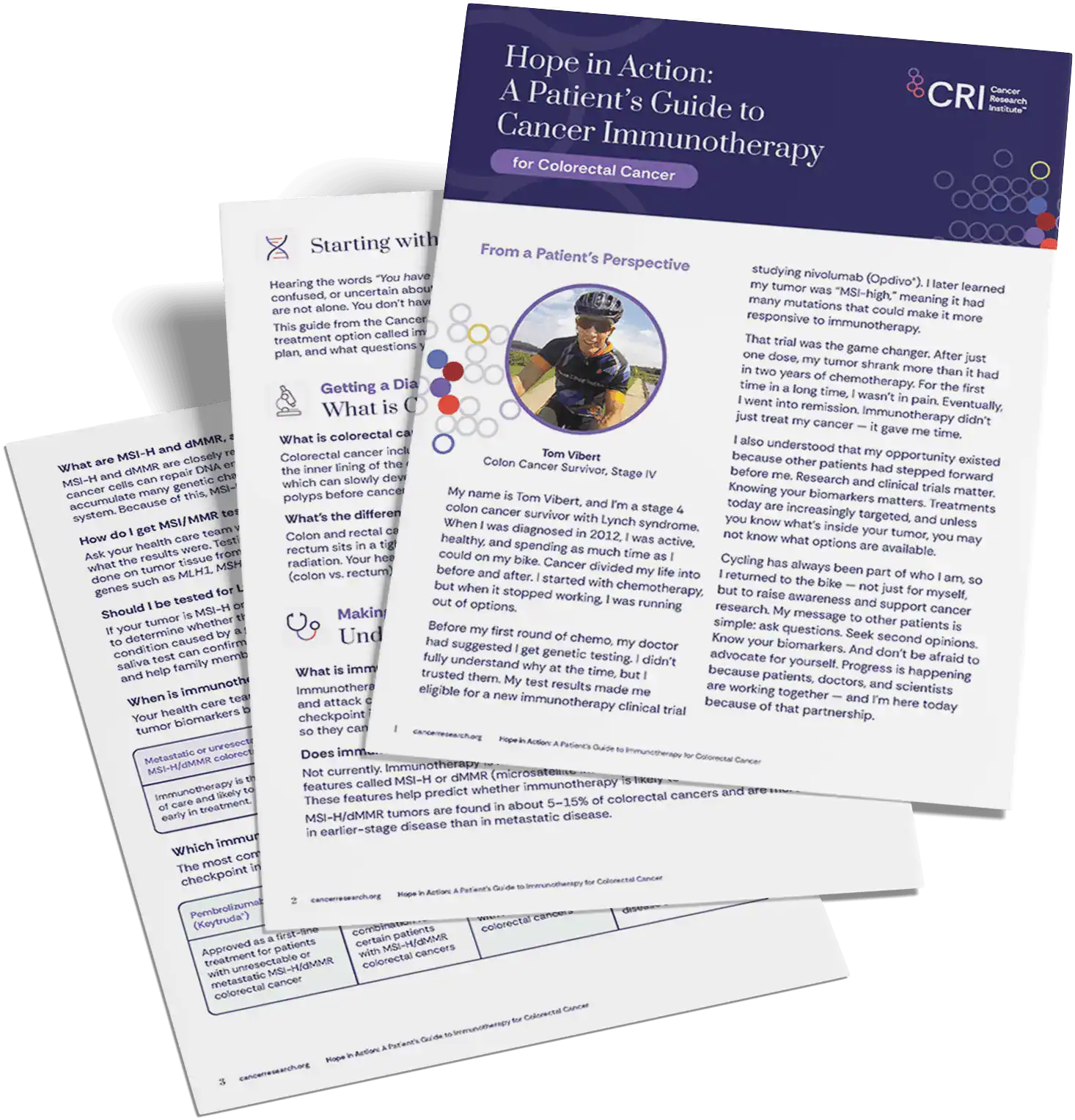
A Patient’s Guide to Immunotherapy for Colorectal Cancer
Your path to understanding colorectal cancer immunotherapy — guided by survivors, experts, and hope.
Find a Clinical Trial Near You

Sources
Colorectal Cancer
(2025) World Health Organization
Colorectal Cancer Statistics
(2026) American Cancer Society
Colorectal Cancer Survival Rates
(2025) National Cancer Institute (SEER)
Colorectal Cancer Screening
(2025) U.S. Centers for Disease Control and Prevention
Colorectal Cancer Screening Recommendation
(2021) U.S. Preventive Services Task Force
FDA Approves Pembrolizumab for MSI-H or dMMR Colorectal Cancer
(2020) U.S. FDA
FDA Approves Nivolumab for MSI-H or dMMR Metastatic Colorectal Cancer
(2017) U.S. FDA
FDA Approves Nivolumab in Combination with Ipilimumab for MSI-H or dMMR Colorectal Cancer
(2018) U.S. FDA
FDA Grants Approval for Dostarlimab for dMMR Solid Tumors
(2021) U.S. FDA
Lynch Syndrome Increases Colorectal Cancer Risk
(2025) American Cancer Society
Join CRI in Shaping the Future of Immunotherapy
Support the pioneering work of CRI in advancing cancer research.