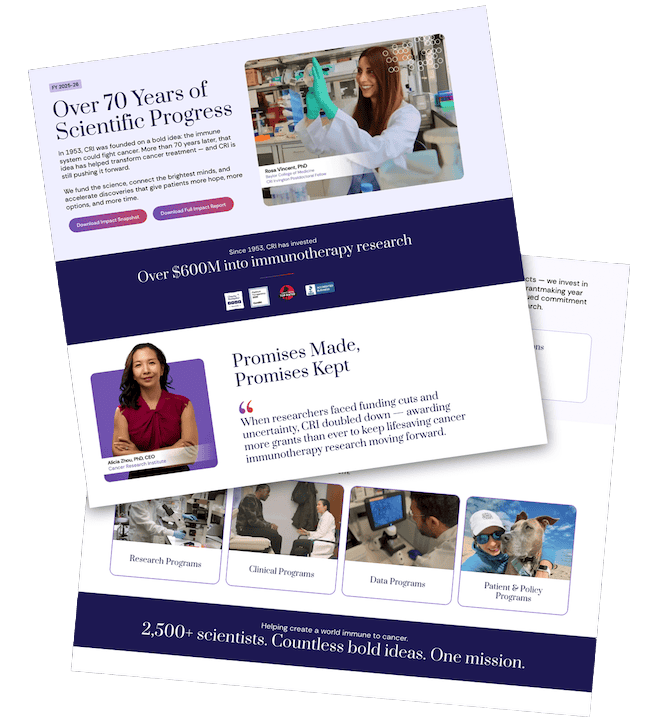
There are moments when an organization’s mission is tested not by opportunity, but by uncertainty. This past year was one of those moments.
As researchers across the country faced funding cuts and an increasingly uncertain environment, the Cancer Research Institute (CRI) made a deliberate choice: keep science moving forward.
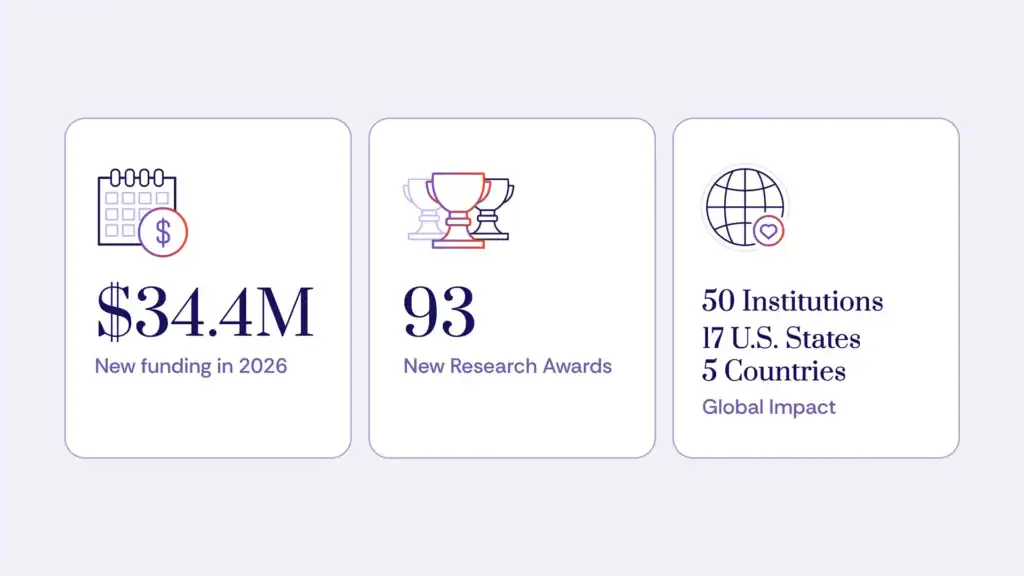
In fiscal year 2025–26, CRI committed $34.4 million in new funding across 93 awards — our largest grantmaking year ever. These investments reached scientists at 50 institutions across five countries and 17 states. But the numbers tell only part of the story.
Behind every award is a scientist pursuing an important question. Some are launching their careers. Others are establishing independent laboratories or leading ambitious programs capable of changing the direction of the field. At every stage, they need more than a good idea. They need the resources, flexibility, and confidence of funders willing to invest in what their work could make possible.
For more than 70 years, CRI has made that investment. We have supported exceptional scientists before their greatest discoveries were made, giving them the freedom to follow the science and take the risks that meaningful progress often requires.
The new CRI IGNITE Award is one way we are keeping that promise.
The transition from postdoctoral training to an independent research career is one of the most consequential — and vulnerable — periods in a scientist’s professional journey. Researchers must establish their own laboratories, define original areas of investigation, and generate the early evidence needed to compete for long-term funding. Promising ideas can stall during this transition, not because they lack potential, but because the support needed to pursue them is difficult to secure.
CRI created IGNITE — Inspiring Growth and Nurturing Independence Through Excellence — to help exceptional early-career scientists bridge that gap. The award provides support at precisely the moment when talented researchers are ready to build independent programs and pursue bold questions of their own.
Simone Park, PhD, an inaugural IGNITE Award recipient at the University of Pennsylvania, exemplifies what this kind of sustained investment can accomplish.

CRI first supported Dr. Park as a postdoctoral fellow. Today, as she takes the next step in her career, IGNITE is helping her establish an independent research program focused on tissue-resident memory T cells — specialized immune cells that remain in tissues and may provide lasting protection against cancer recurrence.
Dr. Park’s research asks what enables these cells to persist and continue acting as powerful anti-tumor defenders. By uncovering the biology behind their durability, she hopes to identify new strategies for creating stronger, longer-lasting immune protection against cancer.
Her path reflects more than an individual achievement. It demonstrates the value of supporting promising scientists throughout their careers: helping them develop expertise, build independence, and grow into the scientific leaders who will shape the future of cancer immunotherapy.
This long-term approach is central to CRI’s impact. Our programs form a continuum of support — from postdoctoral fellowships that launch research careers, to IGNITE Awards that foster independence, to CRI Lloyd J. Old STAR Awards that give established investigators the freedom to pursue high-risk, high-impact ideas. Together, these programs help ensure that exceptional people have opportunities to advance their work at pivotal moments.
Our commitment extends beyond research awards. CRI also advances clinical studies, develops data programs and shared resources, equips scientists with new computational skills, and helps patients and caregivers navigate cancer immunotherapy through trusted information and support. Each investment contributes to a broader ecosystem designed to move discovery forward and translate increasingly complex biology into better treatments for patients.
Our 2026 Annual Impact Report captures what that commitment made possible during a record-setting year. It is a record of promises kept — to scientists whose ideas deserve the chance to grow, to patients waiting for new possibilities, and to supporters who believe in the power of research to change lives.
Uncertainty may alter the landscape in which science advances, but it does not change what progress requires: exceptional people, bold ideas, and the sustained support to bring them together.
There is extraordinary work still ahead of us. And we’re just getting started.