
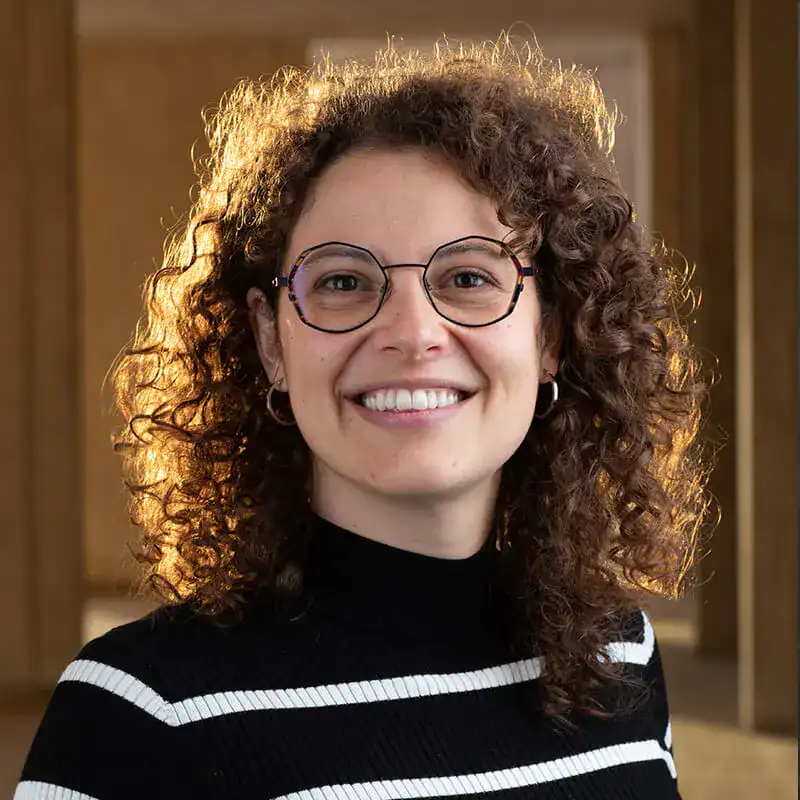
Even with major advances in cancer immunotherapy, many tumors continue to evade immune detection and resist treatment. Most current therapies focus on activating T cells—the immune system’s direct cancer killers—but another key player, the B cell, may hold untapped potential. B cells can enhance anti-tumor immunity by producing antibodies and by presenting tumor fragments, or antigens, to T cells to broaden their attack. Dr. Georgia Lattanzi’s research seeks to understand how B cells expand and diversify immune responses against cancer, a process that could help overcome resistance to current therapies.
Dr. Lattanzi’s project investigates how tiny particles released by tumor cells, known as tumor extracellular vesicles (tEVs), activate B cells to coordinate stronger and more comprehensive immune attacks. Her studies suggest that tEVs carry tumor-associated proteins to nearby lymph nodes, where they stimulate B cells to “teach” T cells to recognize additional tumor targets—effectively broadening the immune system’s ability to detect and destroy cancer cells. By uncovering how this B cell–driven communication amplifies T cell responses, Dr. Lattanzi aims to identify new strategies that engage both arms of the immune system to create more durable and effective cancer treatments.
Dr. Lattanzi is a cancer immunologist with expertise spanning molecular oncology, microbiome–immune interactions, and translational immunotherapy. Her research integrates fundamental and applied approaches to understand how immune cells collaborate to eliminate cancer. Building on these insights, she aims to translate discoveries about B and T cell cooperation into new combination immunotherapies that produce stronger, longer-lasting responses for patients who do not benefit from current treatments.
Sponsor
Daniel Hollern, PhD
Projects and Grants
Deciphering the Mechanisms of B Cell–Mediated Epitope Spreading in Cancer